
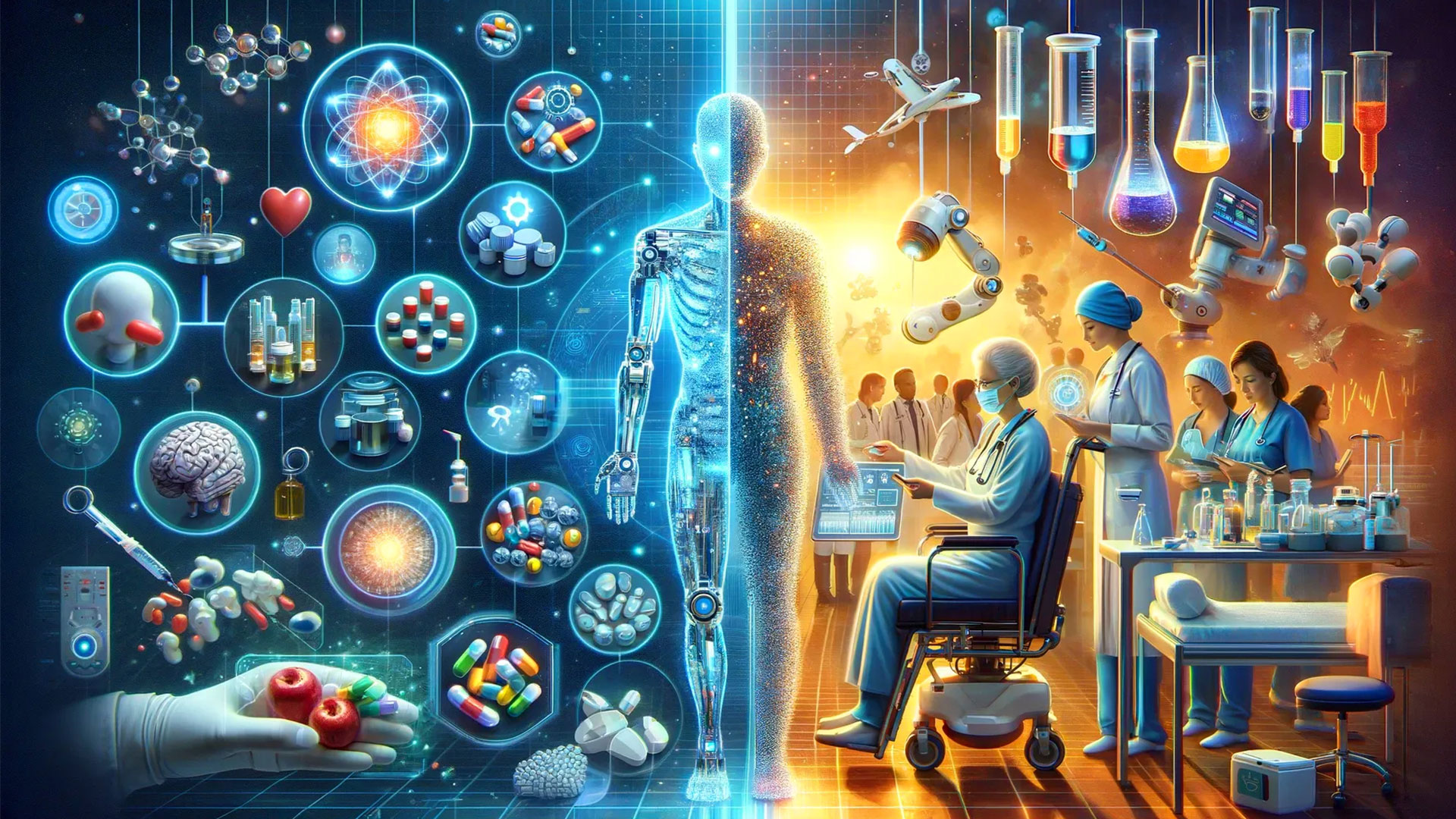
Medical Code: Enabling early diagnosis and cutting costs, AI technology is seen as a saviour in healthcare

The transformative effects of machine learning and the onset of AI in healthcare systems around the world have huge implications for the improvement of our wellbeing. From better and faster diagnosis to understanding and managing symptoms to drug development, as well as the more efficient management of the systems themselves, the potential is almost endless.

AI has already woven itself into our lives through recommendations on social media as to what content we should click on and which adverts we see. AI systems utilise a user’s profile and demographic to make these decisions. Now, as its tools become increasingly applied to support healthcare, it may offer humanity more meaningful and lasting benefits.

Predictive power

Artificial Intelligence is a statistical software using algorithms that can find patterns in large amounts of data, whether words, images, video, audio, code, or even DNA, and then make predictions based upon these. This is different from the early days of computers, which were essentially based on a list of instructions similar to how calculators operate. Modern AI or machine-learning systems – ML being a subset of AI – predict what is the most likely outcome for something. As such, there is no definitive answer, but the technology considers what should come next based upon what it has seen in the past.

This formula is the building block for ChatGPT, which has the ability to find relationships between different words to predict which one should come next in a sentence, and ultimately compose advanced academic reports. The implication of this skill in making sense of big data from disparate sources is now becoming increasingly apparent in the provision of healthcare as medical research increasingly moves from code to clinic.

Success in sight

In ophthalmology, for example, AI is being used to prevent blindness. Pearse Keane, a Consultant Ophthalmologist at Moorfields Eye Hospital in the UK who specialises in the treatment of retinal disease and age-related macular degeneration, first considered the potential of artificial intelligence because patients were experiencing delays in getting an appointment with a doctor. Some, in critical cases, went blind as a result. He thought applying an AI system to data gleaned from retinal scans would help identify those whose sight was most under threat and enable them to receive attention within a few days rather than weeks or months.

He approached the co-founders of AI research laboratory DeepMind. “I told them we were doing 1,000 retinal scans per day at Moorfields and can we work together to develop an AI system to prevent blindness,” he relates in a BBC podcast. “The rest is history.”

Researchers at Moorfields shared about one million anonymised, historical scans with DeepMind and, essentially, trained AI algorithms to recognise eye disease. The performance of this powerful AI technology was “on par with world-leading experts from Moorfields for more than 50 different retinal diseases,” says Keane.

Window to the body

Interestingly, the retinal scans are also being considered for a new field called oculomics. The idea of using the eye as a window to the rest of the body to detect health conditions has been postulated for over a century. However, the ability to crunch and analyse vast amounts of data at speed has spawned a potential breakthrough. Keane enthuses: “What has been really exciting in the last four or five years is this idea that if you combine advanced retinal imaging with big data, with the latest advances in AI, it turns out that you can actually potentially predict Parkinson’s disease or dementia, or predict the risk of heart attack or stroke.”
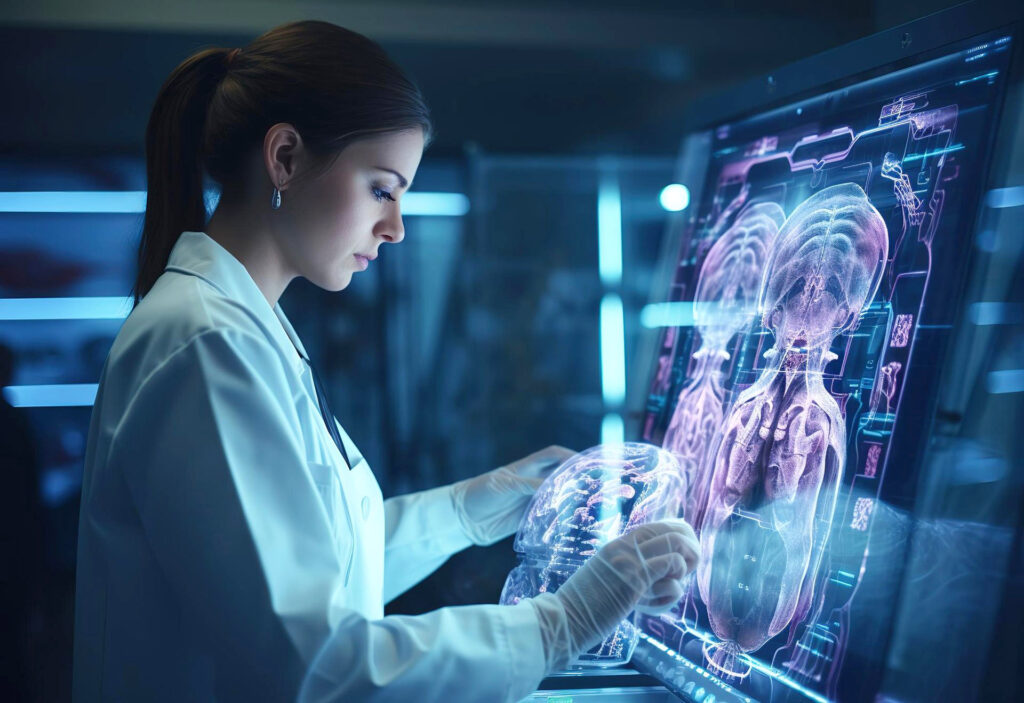
Although Keane is hopeful this technology will be widely available on an open-source basis within two or three years, he cautions: “But the caveat to that is we are still at the proof of concept; we are still pushing research-paper stage.”

Cancer detection tools

The life-saving potential of software trained to analyse millions and millions of scans was recently highlighted by an AI system called Mia used by the NHS in Scotland to detect signs of breast cancer that may be indiscernible to the human eye. Mia analysed the mammograms of more than 10,000 women and was able to flag all those with cancer, as well as an extra 11 the doctors did not identify. This ability to detect cancer at a much earlier stage could make the difference between survival and a potential early death, given that tumours can grow and spread very quickly.

Here in Hong Kong, researchers at the Hong Kong University of Science and Technology (HKUST) recently developed AI-based tools to detect 30 types of cancers and diseases. The university has developed four models which they believe are poised to transform the medical and healthcare fields, surpassing existing models due to their foundation on extensive data sets and novel machine-training strategies. Their breast-cancer diagnostic tool is said to achieve accuracy levels comparable to radiologists with five or more years of experience.

Another tool is poised to act like a “medical GPT”, with the ability to answer questions, generate medical reports, and provide initial diagnoses based on medical images. A further tool called XAIM (Explainable AI) is designed to enhance healthcare professionals’ confidence in adopting AI by explaining how medical AI models reach their decisions. Researchers at the university suggest that while many AI models offer high accuracy, they often lack transparency, and this leads to scepticism about their adoption.

“XAIM addresses this by providing visual and textual explanations of the models,” says a spokesperson for HKUST, which has previously developed an AI model predicting the prognosis of brain-tumour patients and a highly accurate blood test for early detection of Alzheimer’s disease.

Big data doubts

For sceptics, one of the issues with using AI in healthcare is that it relies on a vast data set and its output will necessarily reflect that data set and also any errors or specific biases it contains. For instance, marginalised populations who do not access healthcare will not be reflected in the data and the results will not therefore serve the population as a whole. Another concern is that models are perceived as having a “non-deterministic” nature, meaning they will not always respond in the same way and make the same predictions to the same stimuli. Privacy of personal data has also been flagged as an issue.
There is also the question of accountability. For instance, if an AI model is used to determine which patient receives a heart transplant and which does not, then who would be accountable if that judgment is subsequently proved to be wrong?

Dr Jessica Morley, a Postdoctoral Researcher at Yale University’s Digital Ethics Centre, believes current AI modelling lacks transparency, especially given the complexity of its development. She tells the BBC podcast this is the crux of the AI conundrum: “If we have come to the point where something the algorithm is making a “wrong” decision – where did the wrongness start? Is it who collected the data? Is it who curated it? So how did you decide what was cleaned and what was not? Is it who designed the model or who evaluated the model? Is it who interpreted the model?”

AI concerns and hopes

These sorts of ethical considerations are behind recent calls in Hong Kong for guardrails and protection to be put in place before the widespread rollout of AI in healthcare and other sectors, such as finance.

However, many in healthcare have high hopes that AI can also reap efficiency savings and increase productivity. Tools such as AI-backed voice transcriptions, for instance, could save a huge amount of time and cost for a health system. In 2022, a McKinsey report suggested using AI to predict diagnostics outcomes and support clinical decisions could create US$5 billion in economic value in China. Many poorer nations across Africa could also derive immense benefits from AI in healthcare.


Zest Players: Go all-out with the colour of year

reimagined and elevated.

Look 1

Look 2

Look 3

Look 4

Look 5

Look 6

Look 7

Look 8

Look 9

All images are A.I generated.

Stripes Universe: Lines, cut, colour and shapes for all

Start the year right with fresh lines, cuts, colours and shapes.

Look 1

Look 2

Look 3

Look 4

Look 5

Look 6

Look 7

Look 8

Look 9

All images are A.I generated.

Elevate Your Skills with the Most In-Demand Online Courses

For those of you who are looking to broaden your horizons, learn new skills, or enhance your knowledge, online learning is undoubtedly a powerful tool that can expand your opportunities and transform your future. With an abundance of educational resources available on the internet, even offered by top universities, it can be challenging to determine which courses are worth your attention. That is why, we’ve handpicked the best online courses that offer top-quality educational experiences. Whether you’re seeking to advance your career or develop your creativity, we’ve curated a list of courses that cater to different interests. Continue reading to check them out.

Business Analysis

certification courses

Whether you are determined to start your own business or going to take over your family’s, taking online courses in business analysis can be very useful for you. This course will teach you to make informed and well-calculated decisions for your brand or company based on data. In other words, you will gain knowledge in breaking down different aspects of your business and creating visual data to identify weak points so that you can make improvements.

Best Business Analyst Course: Harvard Business Analytics Programme

Taught by professors from the prestigious Ivy League school, the Harvard Business Analytics Programme is certainly one of the best in the field because you will be trained in both the analytical and application aspects, thus learning not only to map out data but using the results to escalate your company’s profits too. Moreover, this particular course also prepares you to excel in a technology-forward world as the course will include modules on blockchain, artificial intelligence and more.

Cost: US$51,500 (HK$402,000)
Duration: 9 months
Weekly Commitment: 10 to 20 hours
Click here to enrol in the course.
Artificial Intelligence

certification courses

With ongoing conversations and fear about which occupations will be replaced by artificial intelligence in the future, there is one surefire way to take advantage of AI, especially with more companies trying to implement AI to improve the efficiency of their work. It is signing up for online courses that teach you to create AI programmes that will aid people in performing their daily tasks. Besides, AI is not just used in office spaces, it is also being used in other sectors such as banking, transportation and more.

Best Artificial Intelligence Course: AI Foundations for Everyone Specialization by IBM

Perfect for people who have a new-found curiosity in artificial intelligence but have no background in IT (Information Technology) or coding, this course offered by IBM teaches all the basics you will need to know. The activity-based programme is divided into three parts – introduction to AI, understanding the AI platform IBM Watson AI and creating AI programmes – that allow you to develop a chatbot using the IBM Watson AI.

Cost: US$137 (HK$1070) for an annual subscription
Duration: 3 months
Weekly Commitment: 2 hours
Click here to enrol in the course.

Also Read: Transform or Die: Now a chatter of fact not science fiction, AI is changing the human experience

Music Instrument

online courses

If you are someone who is passionate about music and has wanted to learn to play a musical instrument, then you can join a course to check that off your wish list. You can learn to play the guitar, an ukulele, a flute, a piano or any instrument of choice and it doesn’t matter whether you will be producing music for your very own entertainment or you will be selling your compositions and making money out of it.

Best Music Instrument Course: MasterClass

MasterClass is a coveted online learning platform that prides itself on offering online courses that are taught by industry experts and so will be the case if you plan to learn music on this website. Some of the music classes that MasterClass has to offer include vocal training with Mariah Carey, songwriting with John Legend, ukulele with Jake Shimabukuro, electric guitar with Tom Morello, and many more with leading artists as your teacher.

Cost: US$120 (HK$940) for an annual subscription
Duration: anywhere between 2 to 10 hours
Click here to enrol in a course.

Also Read: BandLab – The One-Stop Creative Social Platform For Every Musician

Screenwriting

online courses

For those creative minds who have an interesting story that they wish to turn into a movie or series, or dream to join the writing team of a television network, you should take a screenwriting course. Taking a course in screenwriting will teach you to write a script that will allow any reader to envision a story based on dialogues and descriptions. Simultaneously, a screenwriting course will also prepare you to write full-fledged scripts in a limited time period because once you start writing professionally, you will have to meet tight deadlines.

Best Screenwriting Course: Writing a TV Series and Screenwriting for Films by AFTRS

The Australian Film Television and Radio School trains people who would like to work in the entertainment industry, particularly those who want to work behind the scenes. As a result, it offers a range of courses, including ones that will give you an insight into screenwriting and have you ready to write your own script. Based on whether you want to write for a movie or TV show, you can pick the right option and learn how to develop different characters and multiple storylines in a single script.

Cost: AU$1400 (HK$7400)
Duration: 10 weeks

Weekly Commitment: 2 hours
Click here to enrol in the course.

Social Media Marketing

online courses

Though anyone can create a social media account, not everyone can make a full-fledged career out of it. Imagine being able to post a single photo on your Instagram page and earning thousands of dollars for it. That would be possible if you understand social media marketing and learn how to get the best out of your social media posts by increasing your reach and engagement on different platforms like Instagram, Twitter, Meta and others.

Best Social Media Marketing Course: Meta Social Media Marketing Professional Certificate

What better place to learn about social media than from Meta itself which runs Facebook and Instagram. Through this course, you will familiarise yourself with maximising the potential of your profile so that you can drive more traffic to your page and posts. Simultaneously, you will also learn how to create ad campaigns that will help you get the results of your expectations.

Cost: US$59 (HK$460) for a monthly subscription
Duration: 4 months
Weekly Commitment: 3 hours
Click here to enrol in the course.

Transform or Die: Now a chatter of fact not science fiction, AI is changing the human experience

Prophesies of doom and media hullabaloo surrounding Artificial Intelligence (AI) have hit the headlines for years – but this time it seems different. It is who and how many are creating the noise.

A Goldman Sachs report in March sounded the alarm bells, warning that AI could replace the equivalent of 300 million jobs. Soon after, the world’s richest man, Elon Musk, got in on the act – along with 1,800 technology researchers and executives – calling for a six-month pause in the development of AI systems such as OpenAI’s GPT-4 (the latest version of the groundbreaking tech that powers ChatGPT). They warned that powerful digital minds were being created “that no-one – not even their creators – can understand, predict or reliably control”.

More recently, even more dire warnings have been sounded, with experts such as the heads of OpenAI and Google DeepMind postulating that AI could lead to the extinction of humanity. AI pioneer Yoshua Bengio also called for urgent action to protect the public.

Accessible & disruptive

The launch of OpenAI’s ChatGPT has been transformational. While chatbots have been around for some years, and have been considered for a whole range of industrial uses from logistics to medicine, this latest computer chatterbox has astounded commentators with its language ability. Aside from its conversational aplomb, it has shown its versatility with capabilities for writing music, debugging computer programs and completing high-level academic examinations.

Sean McMinn is the Director of the Center for Education Innovation at the Hong Kong University of Science and Technology (HKUST), where he manages a special teaching and learning development fund specific to AI called the Education and Generative AI (EDGE-AI) projects fund. He believes ChatGPT’s accessibility is the key game-changer.

“This is about accessibility and ease of use,” he says. “AI tools have been developing for a number of years, but they have never been too widely accessible. The user interface of ChatGPT [though] is extremely basic and anyone with a device and internet connection can interact with the Chatbot with ease. Because of this, and the perceived usefulness of the output it generates, it is not surprising that it has gained such attention worldwide. Add to that, the [AI] tools are more powerful than they were just a year ago.”

McMinn believes it is largely irrelevant that most people do not understand the technology that ChatGPT is built on, namely Large Language Models (LLMs). By far the most important consideration is that it is a very disruptive technology.

Academia alarm The academic community has been particularly perturbed by the latest developments in AI. ChatGPT (GPT stands for Generative Pre-trained Transformer) can write introductions to scientific articles, high-level computational mathematics and even college courses. The University of Hong Kong was initially so concerned that it implemented a blanket ban on its use; they have since softened their stance, greenlighting ChatGPT for staff (but not student) use until guidelines are introduced. Hong Kong Baptist University is also developing guidelines. One of McMinn’s main roles at HKUST is to explore technology-enhanced teaching and learning (TETL) methods and advise university management and faculty on strategies for implementing such initiatives. “While a lot is still unknown and speculative, many people believe that AI has the potential to enhance or transform how we teach and assess,” he says.

Following the ongoing speculation and uncertainty about the impact of generative AI on the education sector and workplace, he readily understands why some institutions may choose a cautious approach. The overriding issue concerns integrity. “How do we know what students submit is their own work? Do we have valid evidence that they are learning? Are the assessment tools teachers are using able to distinguish AI output and student outcomes?”

He believes the uncertainty surrounding the issue could have some positives – spurring into action institutions which have been slow to revamp how and what they teach and forcing a review of what knowledge and skills students need in today’s fast-changing world.

McMinn does voice concerns that banning the use of generative AI tools may be doing our students a disservice, and he advocates a shift of energy towards preparing students for an AIdriven world. “These tools are not going away; in fact, we will probably see faster advancement in the next few years,” he says. “We should be preparing students for the future of work where AI tools will be commonplace in the workforce.”

Workplace worries

Speculation has been rampant about which jobs will be affected or lost as a result of recent developments. The Goldman Sachs report said AI could assume about a quarter of the work now done by humans. Accountants, lawyers, doctors, journalists, data managers and professionals in other sectors are all thought to be at risk from an AI surge, and there has been speculation that Hollywood film studios might consider replacing writers with generative artificial intelligence.

“Many professions that rely on creativity will be disrupted, but I am not certain they will disappear completely. In some ways, AI tools have the affordance for new forms of creativity. I think there will still be a need for writers – just in a different form perhaps,” says McMinn.

He does believe ChatGPT has limited the need for brainstorming and drafting. “Now, we can generate ideas and drafts, and spend more time on editing. So, knowing that process will change, we can start to focus on higher-order tasks that require more analytical thinking.”

There are various tools available in Hong Kong to assist with writing and brainstorming ideas – Poe.com, Bing Chat, and Google Bard via a VPN. But he warns: “Always check the content these tools generate. LLMs hallucinate and there is a lot of inherent bias that could be harmful to users.”

Google is slowly integrating its AI into its search engine, much the same way Microsoft integrated Bing into theirs. “I think users will just interact differently with Google and Microsoft’s Bing search,” he says.

Some professionals may need to think about upskilling or reskilling, and acquiring expertise relevant to their career that AI cannot master. McMinn is confident jobs that do not exist now will emerge in the AI-driven near future. “AI still lacks contextual awareness or metacognitive tasks. Humans will still be important for critical and relative thinking, as well as problem-solving for tasks that are contextual,” he says.

Ethical issues

There are undoubtedly complex issues surrounding the widespread dissemination of AI. A US lawyer recently admitted to using AI for case research. Part of McMinn’s role at the university is to highlight the ethical implications of such technology and ensure stakeholders are aware of the implications.

One concern is information bias. The New Scientist recently highlighted the implications of how ChatGPT and GPT-4 are more familiar with books that appear online. “Always be cognisant that these tools are inherently biased,” says McMinn. “Much of the bias is inherited by the data sets used to train the AI tools, but also the content policies developed by the companies. Most of these biases are unintentional, but they are there.”

Since misinformation spread at a rapid rate will have societal implications, institutions and companies need to develop clear AI policies and guidelines for their stakeholders. Apple co-founder Steve Wozniak recently said AI may make scams harder to spot.

“I do also worry that these tools may reinforce echo chambers, especially with all the talk of personalising experiences with AI,” says McMinn. “We also need to be mindful that bad actors will use these tools to scam people.”

Being human

Educator Svetlana Chigaeva-Heddad has been exploring the capabilities and limitations of ChatGPT and other Gen AI technology. “I cannot emphasise enough how important it is to think through the process of engaging with these tools and reflecting on what our engagement with these tools means for us as humans and for our agency in the future,” she says.

Pointing out the connection between language and thought, she adds: “Given that generative AI tools are based on human language, is it really impossible to imagine that there may be artificial general intelligence which will be able to think like humans and perform tasks at the highest levels that we currently assume to be unique to humans?”

Woman to Watch: Ariel Yang on creative arts to teaching to regenerative medicine…

Not only does Ariel Yang serve as Executive Director for skin specialist company DS Regenerative Medicine, the accomplished multitasker is also prepping the next generation in the ways of artificial intelligence…

Yang at Heart From creative arts to teaching to regenerative medicine, Ariel Yang is comfortable in her own skin gafencu people interview March 2022
Earrings, necklace, bracelet by Van Cleef & Arpels; Jacket and pants by Alexander McQueen; Top by La Perla; Heels by Gianvito Rossi

What were your early years like?
I could probably sum up my childhood self in four words: well-behaved, sensible, affectionate and filial. I was born in a really small town outside Wenzhou in Zhejiang Province, and I lived with a large extended family aside from my parents, so it was a really lovely, warm and supportive environment to grow up in.

Did you have any particular career aspirations as a child?
To be honest, I was always creative as a child, but my parents weren’t keen on me going down that track. Understandably, they wanted me to pursue something more traditionally acceptable in their eyes. One of my uncle was a postdoctoral fellow at Peking University, and my father – who was a teacher – was adamant that I followed in their footsteps, so back of my mind I always knew that a career in education was a significant possibility.

Is that the path you took initially?
Well, after graduating from high school, I enrolled at the Qianjiang College of Hangzhou Normal University to study tourism management. My first job right after receiving my degree was to teach at Zhejiang University’s Faculty of Science, followed by a stint in its School of Management. I guess you could say I ended up fulfilling my father’s wishes.

Yang at Heart From creative arts to teaching to regenerative medicine, Ariel Yang is comfortable in her own skin gafencu people interview March 2022 (3)
Earrings, jacket, belt, long skirt and boots by Dior; Rings by Van Cleef & Arpels

What spurred your move from Shanghai to Hong Kong in 2017?
After I left my teaching job, I moved to Shanghai and pursued something a little closer to my original interests – working as a designer for a Chinese jewellery business. By that time, Hong Kong was already renowned as an international centre for the industry, so I thought moving here would be good for my career. On top of that, the city’s status as a leading financial and cultural hub was very attractive to me. I felt I could meet talented individuals and have a much more multicultural experience, so I packed my bags and left Shanghai for Hong Kong.

“I felt I could meet talented individuals [in Hong Kong] and have a much more multicultural experience”

How did you become involved in the business of skin health?
I guess my husband can take some of the credit here as he was the one who got me thinking about investing in a company. I first met him, through a student of mine, long ago during my early teaching years and we stayed in touch. We just happened to reconnect romantically around the time I came to Hong Kong – he’d moved here just before me. As he was in the business of investing, I picked up some tips and tricks of the trade from him.

So, when the opportunity arose to invest in DS Regenerative Medicine prior to its listing on the Hong Kong Stock Exchange in 2017, this budding interest paired with my lifelong passion for beauty and skincare meant I absolutely jumped at the chance. It was a great decision, and as a company we’ve gone from strength to strength.

What exactly does DS Regenerative Medicine specialise in?
Basically, we’re a group of skin specialists who place emphasis on regenerative medicine. Perhaps our strongest service is treating certain forms of skin cancer. In particular, we use a specialised procedure called Mohs Micrographic Surgery. With carcinomas, early detection is vital; most people don’t really pay attention to spots when they appear, but it’s critical to get any skin abnormalities checked out right away. The next step is to treat them immediately. Post-surgical care is equally important, and our dermatologists are skilled in ensuring that there’s minimal evidence afterwards that the patient has had skin cancer – especially when such blemishes occur on the face.

Aside from cancers, our medical experts and regenerative skincare doctors are adept at treating a wide-ranging array of skin conditions, be it itchy, flaky skin, alopecia or eczema. We also specialise in medical imaging, from CT scans to MRIs. Finally, there’s our in-house DS Skin & Wellness Clinic skincare line, which has been specially developed by our dermatologists and chemists to help achieve and maintain healthy skin.

Yang at Heart From creative arts to teaching to regenerative medicine, Ariel Yang is comfortable in her own skin gafencu people interview March 2022 (4)
Earrings, jacket, top, chain belt, shorts and heels by YSL
Rings by Van Cleef & Arpels

Where did the company originate?
It started as a dermatological clinic in Singapore back in 2005, and today, it’s the largest private practice skin clinic in the city, with five locations as well as an outpost in Kuala Lumpur. We decided to launch operations in Hong Kong as we wanted to take advantage of the city’s unique location as a global hub, as well as a potential springboard into China. In fact, we’re launching two new dermatological centres across the border this month – one in Shenzhen and another in Hangzhou.

One of the company’s sub-brands is QR Skin & Laser Centre. This is a regenerative medical centre focused on the skin, with branches in Central – where we are meeting today – and Kowloon Bay.

How has the ongoing pandemic affected your business?
I think I can say that two years of Covid has negatively impacted everyone in the world, and we’re no different. Obviously, we’ve been hit in terms of patient traffic, and we’ve also had to slow down our expansion. Having said that, I’m still optimistic. Not only do we have the medical know-how, but our staff are resilient at heart, so we’ll move forward one step at a time towards the day when everything improves. Hopefully, soon!

Yang at Heart From creative arts to teaching to regenerative medicine, Ariel Yang is comfortable in her own skin gafencu people interview March 2022 (2)
Earrings by Nana Jacqueline; Ring by Boucheron; Belt by Dior
Dress by Alexander McQueen; The Kelly bag by Hermès; Boots by AAR Boutique

Aside from DS, are there any other projects you’re involved with?
Absolutely. Last year, I started a new youth education venture to raise awareness about artificial intelligence. The idea sparked from my own experience as a teacher, and being involved in this new project allows me to go back to my roots in education. Our company currently helps more than 200 primary and secondary schools across Hong Kong, training them to develop requisite skills within this sphere. We also host activities to increase awareness and encourage development, be it annual competitions or even international conferences. I believe it’s something that fills an unmet need, and that’s very meaningful to me.

How do you relax when you have time?
I love hiking as I find it helps me clear my head, but my favourite self-pampering activity is having a massage – full-body ones that just knead and roll away any tension I might be feeling.
If you could go back and meet anyone from your past, who would it be and why?Honestly, I’m someone who lives firmly in the moment, so I don’t believe in looking back. I’m the person I am today because of the decisions I’ve made and people I’ve met along the way.

Yang at Heart From creative arts to teaching to regenerative medicine, Ariel Yang is comfortable in her own skin gafencu people interview March 2022 (5)
Earrings, jacket, top, chain belt, and heels by YSL; Rings by Van Cleef & Arpels

What’s the most interesting thing that has ever happened to you?
That’s a tough question. I have a bad memory, so it’s difficult to pinpoint any particular outstanding moments. I will say, though, that having my son and watching him grow up is the funniest, strangest and warmest thing to happen to me. He’s four now, and seeing the world through his eyes and discovering his likes and dislikes are, for me, the most interesting moments ever.

“I’m someone who lives firmly in the moment, so I don’t believe in looking back”

Finally, tell us a secret about yourself.
Hmm… well, I touched upon this earlier, that I’ve always had a huge creative side. I love the arts and love performing. In fact, as a child, my teacher also said I had a talent for painting. However, ultimately, my parents managed to turn my interests elsewhere, and I have no regrets. Occasionally, though, I do wonder what might have been if I’d followed that passion. I’d probably have been another person entirely! Perhaps one day I’ll translate my love of art into a new business opportunity…

Thank you.


(Interview by: Tenzing Thondup Photographer: Jack Law Art Direction and Styling: Jhoshwa Ledesma Videographer: Kes Lei Venue: QR Skin & Laser Centre Cover look: Earrings by AAR Boutique Ring by Graff Dress by Nana Jacqueline Heels by Amina Muaddi)

2019 digital trend predictions for businesses: How many have you implemented already?

With 2019 just a few days away, is your business ahead of the curve when it comes to digital trend predictions for the next year? Check out our top picks from next year’s digital trends to give your business an edge over your competitors.


digital trend

Artificial Intelligence

With more than 60% of businesses implementing Artificial Intelligence in the last two years (as per Narrative Science reports), AI will continue to be one of the strongest digital trends in 2019 and is predicted to be even more all-pervasive, thanks to ongoing technology improvements.

digital trend

Influencer Marketing

Social media influencers will continue to sway market trends in 2019, with advertising spend on influencer marketing poised to grow up to US$10 billion by 2022, according to the Business Insider Influencer Marketing Report. This is especially true for advertisers who want to target younger audiences.

digital trend

Video Content

According to Tubular Insights, by 2019, 80% of online content will be in the visual form. So while content remains king, it’s safe to say that much of its reign will be dictated by how good it looks visually.

Voice Search

An estimate by Klick, a healthcare, business and workplace solutions conglomerate, predicts that, by 2020, one-third of all Internet search will be done without touch and 50% of these will be through voice. In keeping with this upcoming digital trend, advertisers would have to tweak their keyword optimisation to make it voice-friendly.

digital trend

Visual Recognition

Besides voice, visual search will increase in 2019. With users being able to upload an image of the product they are looking for, the whole search option becomes even more interactive and engaging.  Google, Amazon and Pinterest are just a few of the big names that are already cashing on in this new digital trend.

digital trend

Chatbots

Yet another digital trend to watch out for is the rise of chatbots, the AI-powered assistants the help conversational commerce for websites and mobile apps. A recent study by Oracle has predicted that 80% of businesses are already using chatbots or are planning to use them by 2020.

Augmented Reality/Virtual Reality

As users get more and more accustomed to enhanced multisensory experiences, Augmented Reality and Virtual Reality become a must-have for businesses. According to Statista, the VR and AR market is worth US$27 billion and expected to reach US$209.2 billion in only four years.

Jobsolescence: How Artificial Intelligence will impact the future of work

When the first sabot – a form of heavy wooden work shoe favoured by European peasantry back in the early 19th century – was first chucked into the inner workings of a new-fangled bit of mill machinery, it marked two major developments in humankind’s march onwards. The first was the arrival of a whole new meaning of the word “saboteur” – while previously it had merely been the plural of sabot. Perhaps more significantly, it was also, arguably, the first instance of the workers of the world apparently fearing jobsolescence at the hands of machinery. Since then, it has been a concern that has echoed and re-echoed down the ages.

Jobsolescence - the Future of Work is AI-driven

First, it was the looms that were supposedly set to end humanity’s apparent right to work from dawn to dusk in appalling conditions for even more appalling pay. Then it was electricity. Then it was greater automation. Then it was the silicon chip and robotic production lines. Through it all, though, the workforce’s dogged determination to spend all of its healthiest years at the beck and call of the production cycle has always prevailed.

Indeed, as technology has moved forward, people have always remained a vital part of the equation, acting as supplier, worker and customer in equal measure. Greater technologisation also had another direct implication – education. This has led to a huge surge in literacy. According to the OECD, as of 2015, some 86 percent of the world’s adults were able to read and write. Dial back some 200 years, however, and the situation was almost wholly reversed, with only 12 percent having basic literacy skills.

What will the future of work look like

Aside from basic literacy, the changed nature of the workbase currently requires minions that have mastered science, foreign languages and computer programming, among many, many others, as well as a host of interpersonal skills. Unfortunately, the production process is now on the verge of becoming so complex and so autonomous that human operators will face complete jobsolescence. And it’s all down to AI – Artificial Intelligence.

At its peak – which we are well within sight of – AI technology will see the creation of a range of self-aware, self-maintaining, self-improving machines. These will fully integrate with production lines and troubleshoot any problems, while also being able to diagnose their own shortcomings, devise improvements and create blueprints for the next generation of – even smarter – AI systems.

By 2020, 5 million people will face jobsolescence thanks to automated production systems

And so will begin an endless cycle of ever-smarter machines creating even smarter machines, eradicating any failings and weaknesses with each successive generation. With humankind ejected from the process as soon as the first system becomes self-aware enough to do so, we will very quickly be incapable of building such systems on our own. Indeed, we won’t even necessarily understand the precepts and technologies that are being implemented.

And that day isn’t even that far away. In terms of exactly when computers will gain the level of self-awareness that is currently unique in the universe to humanity, 2045 is the year that is being bandied around by many specialists in the field – most notably by Ray Kurzweil, a renowned US scientist, inventor and futurist. That date, though – which is just 27 years hence – does not mean that humanity’s AI-driven obsolescence is currently on hold.

By 2030, over 800 million humans will face jobsolescence thanks to artificial intelligence

According to the World Economic Forum, the highly-authoritative annual Geneva-held international think tank, by 2020 – just two years away – five million jobs will have been lost globally to AI-led automation. That equates to a nation the size of Norway suddenly facing utter jobsolescence.

By 2030, as self-aware AI creeps incrementally ever closer, the number of jobs lost forever to all things automated will be around 800 million, according to a study recently concluded by the McKinsey Global Institute. In just 12 years’ time, that’s roughly every man, woman and child in Germany – Western Europe’s largest country by population – having zero employment prospects.

Humanity will face utter jobsolescence when Artificial Intelligence takes over production

The rate of jobsolescence will then increase exponentially. Within a generation or two – three at most – every aspect of the production of the world’s wants (from mining raw materials to home delivery) could proceed, more efficiently than ever, without a single human ever being involved.

With humanity out of work, that begs another rather obvious question – what will become of humankind? Will we loll around as our mechanical minions pander to our every need? Or will the sentient systems, themselves, decide just what the fate of this post-AI world will be?

While the answers to these questions are currently far from clear, one thing, however, is chillingly apparent – many of us will still be around to find out.

Text: William Elliot
Photos: AFP

Google Duplex: AI assistant could soon make your appointments for you

Continual and unrelenting advancements in the field of Artificial Intelligence (AI) have become the norm rather than the exception these days. As we highlighted in our in-depth AI feature, it has become an inherent part of our day-to-day lives, be it through smartphones, home and office security, credit card safety and so forth. And now, Google has apparently pushed the boundaries even further with its recently-unveiled Google Duplex system.

For the uninitiated, Duplex was created as a planned future add-on to the Google Assistant’s already-expansive bag of tricks. Thanks to cutting-edge developments in AI and voice recognition technology, it will allegedly enable your gadget to set up appointments on your behalf, be it a restaurant reservation or a session with your hairdresser.

The tech innovator has positioned Google Duplex to help the roughly 60 percent of small business with no access to automated systems gain entry to its massive user base. However, as soon as the company’s CEO Sundar Pichai played a demo at the Google I/O 2018 keynote address, some questions were raised about the very human voice emulated by the system, most notably whether its life-like voice would create false impressions on those humans it’s set to interact with.

The Google Duplex has raised some concerns in terms of life-like voice

While such ethical questions are part and parcel of any advancements in robotics and AI, one thing is very clear. The Google Duplex system is invariably the next step in the journey to symbiosis between man and machine that our future will no doubt embody.

Video: Jeffrey Grubb

Apocalypse Imminent: Will Artificial Intelligence eventually destroy humanity?

When acclaimed theoretical physicist Stephen Hawking died back in March, his many achievements and convictions were again revisited by the scientific community. Not much attention, though, was paid to his conclusions about Artificial Intelligence (AI) posing the greatest threat to mankind’s continued existence.

Artificial Intelligence
Stephen Hawking predicted AI would eventually destroy humanity

During one his many unequivocal statements as to the extent of the threat, he said: “Unless we learn how to prepare for, and avoid, the potential risks, the rise of AI could be the worst event in the history of our civilisation.”

Given Hawking’ intellect and reputation, it would be foolhardy to ignore his warnings. Just what is Artificial Intelligence and why did it make the eminent cosmologist quite so alarmed?

According to John McCarthy, the American computer scientist who first coined the term ‘artificial intelligence’, the answer is straightforward and innocuous sounding: “It’s the science and engineering of making intelligent machines, especially intelligent computer programmes”. In other words, it’s creating computers that have a human-like capacity to think.

Throughout history, this has seemed relatively harmless aspiration on the part of the scientific sector. In 1915, for instance, El Ajedrecista, the world’s first autonomous chess machine made its debut. Although rudimentary, it could play complete games and flag up any illegal moves made by its opponent.

In 1961, things became a little more practicable, with Unimate, the world’s first industrial robot, joining the production line at General Motors’ New Jersey plant.

Machine intelligence may one day far exceed the humans who first devised it

While both these systems were quite basic, Hawking saw them as steps to something far more sinister – the development of machine consciousness. Known by computer scientists as the Singularity, there is a widespread belief that mankind will eventually create an Artificial Superintelligence, a self-aware entity whose technological capabilities and constant self-improving updates would, one day, evolve far beyond the humans who first devised it.

To date, however, no system has passed the Turing Test – an elaborate “interview” procedure that assesses whether any given computer system can interact with a human to the extent that the human believes their respondent is also human.

While that is yet to happen, the current thinking is that a computer capable of passing the Turing Test will been developed by 2029. Just such a prospect has seen a number of luminaries side with Hawking, including Elon Musk, the visionary behind Tesla – a leading manufacturer of electric vehicles and solar panels. Last year, Musk, together with Hawking, was one of 100 scientific luminaries who petitioned the United Nations to ban AI-enabled weapons.

Already, many of AI’s potential military applications have caused worldwide concern. According to a survey conducted by Action Against Armed Violence, a London-based charity, unmanned drone airstrikes killed more than 15,000 civilians in 2017 alone, a year-on-year rise of over 40%.

AI has already insinuated itself into many of our day-to-day interactions

As well as AI’s potential for transforming battlefields, there are also concerns about its impact in the workplace. While some gamely maintain that AI will inevitably create jobs in the future, the consensus is that it will do exactly the opposite.

According to a February 2017 report by McKinsey, global management consultancy, more than 50% of the jobs currently held by humans could be eliminated by 2055, with autonomous systems employed instead.

Despite such glum predictions, not every technocrat is a member of the anti-AI brigade. Welcoming the possibilities opened up by technology, Facebook CEO Mark Zuckerberg says: “One reason I’m so optimistic about AI is the improvements it could offer in terms of basic research systems across so many fields – from diagnosing diseases to keeping us healthy, to improving self-driving cars and keeping us safe.”

On a less grandiose basis, AI has also insinuated itself into many of our day-to-day interactions. Almost entirely without ceremony, it has come to play a key role in road and traffic safety, detecting credit card fraud and home and office security.

So, will Artificial Intelligence be an extinction-level threat or a benevolent companion? While both views have their proponents, it could be that the future will ultimately see man and machine not as antagonists but as allies, working more closely together than could have been envisaged just 50 years ago.

Through a process also known as digital ascension, man and machine will become one

Championing this particular view is Ray Kurzweil, Google’s Director of Engineering and the author of the 2005 bestseller The Singularity is Near. Outlining his theory, he says: “While 2029 is the date I have consistently predicted that an AI will pass the Turing Test, I have set the date for the Singularity as 2045. This is the year, I believe, we will multiply our own effective intelligence a billion-fold by merging with the intelligence we have created.”

In a process also known as digital ascension, man and machine will become one, with human consciousness uploaded to a computer mainframe. It may not accord with Hawking’s belief that Artificial Intelligence will destroy humanity, but it does mean that, post-2045, our descendants may not be recognisably human. That alone may prove that much-missed physicist was right to warn us.

Text: Tenzing Thondup
Photos: AFP