

Vow Wows: Asia’s most stylish traditional wedding gowns

It’s an indisputable fact that the long white dress has come to dominate the world of wedding fashion. Indeed, there are few motifs more ingrained in our collective consciousness when it comes to connubial bliss than a bride clad in a gorgeous all-white creation strolling down the aisle. Interestingly, it is to Britain’s Queen Victoria we have to look as the prime instigator of this particular trend, with the royal in question having opted for a snowy gown for her 1840 wedding to her beloved Prince Albert. This sufficed to inspire many subsequent generations to follow in her footsteps, kicking off a truly global sartorial trend.

Today, the majority of women in the West still choose to get married wearing white wedding dresses, at least if they opt for the full church experience. Their counterparts in the East, however, have a dazzling array of traditional Asian wedding dresses to choose from – be it the multicoloured lehenga of India, the gold-and-red Chinese qipao or the figure-hugging beauty of Thailand’s lush silk chut Thai phra ratcha niyom (often shortened simply to ‘chut Thai’). In fact, for the blushing bride-to-be, the world really can be her wardrobe…

gafencu magazine fashion culture Vow Wows Asia's most stylish traditional wedding gowns india

India
Given the sheer scale of India’s culture, geography and history, it’s no surprise that it’s home to a truly fabulous array of garments, textiles, fabrics and colour choices. It’s small wonder, then, that when an Indian woman gets married, she is most likely stunningly swathed in a legendary lehenga, a truly gorgeous local style of gown.

First introduced to the subcontinent by the Mughals – a tribe of Muslim Central Asians who conquered the region during the 16th century – the lehenga quickly became popular among nobility of the day, while remaining the wedding gown of choice among the country’s most stylish contemporary women. Consisting of a long skirt (with or without pleats) that is fixed at the waist with drawstrings, a fitted, midriff-baring blouse (called a choli), and a flowing dupatta (scarf), elegantly draped around the shoulders, its elegance is truly undeniable.

gafencu magazine fashion culture Vow Wows Asia's most stylish traditional wedding gowns indian
Red remains the favourite shade for lehenga-loving brides-to-be, no doubt because, in the Hindu tradition, the sacred colour symbolises love, strength, passion, fertility and prosperity. All three components of the costume are also typically embroidered with real gold threads, with the amount of gold used denoting the bride’s wealth and status.

gafencu magazine fashion culture Vow Wows Asia's most stylish traditional wedding gowns china

China
Another nation to adopt a scarlet hue in a bid to ensure prosperity and good fortune is China, with this colour often used to mark celebratory occasions, such as the new year, sundry festivals and, of course, weddings. In the case of the latter, it is not uncommon for brides to wear several gowns over the course of the festivities, including a white dress to walk down the aisle.

gafencu magazine fashion culture Vow Wows Asia's most stylish traditional wedding gowns chinese
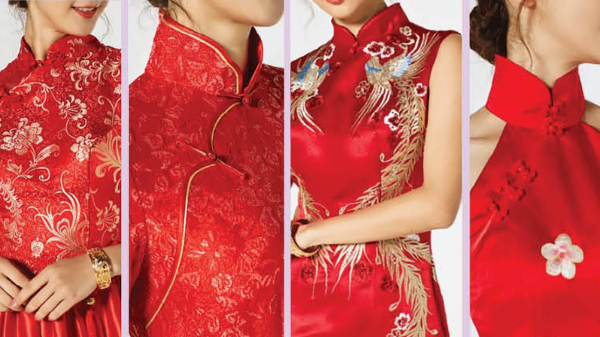
A veritable must for many Chinese wives-to-be, of course, is the traditional qipao (also known as cheongsam in Cantonese-speaking regions) – a one- or two-piece figure-hugging garment made from fine silk, which boasts a mandarin collar with pankou knots (also known as Chinese knots or frog clasps) and comes intricately embroidered with such mythical motifs as phoenixes and dragons. Again, the amount of gold thread utilised in the design showcases the wealth of the bride’s family, with the most opulent gowns often weighing several kilos.

The traditional qipao is a form-fitting affair typically fashioned in an all-but-obligatory scarlet, usually furnished with short sleeves and a mid-thigh slit on the side. Times more contemporary, however, have unleashed a slew of updated interpretations, including sleeveless avatars, multicoloured interpretations and even mermaid silhouettes.

gafencu magazine fashion culture Vow Wows Asia's most stylish traditional wedding gowns thai

Thailand
Prior to the ’60s, the Land of Smiles didn’t actually have a unified national dress. It wasn’t until Queen Sirikit – who in her time was lauded as an international fashion icon, as well as being credited with reviving the popularity of Thai silks – designed the chut Thai in 1964 that her compatriots found they had, at last, been bequeathed a truly unified national costume.

gafencu magazine fashion culture Vow Wows Asia's most stylish traditional wedding gowns thailand

Today, ‘chut Thai’ is an umbrella term encompassing both formal menswear and womenswear, with each region of the country boasting its own unique styling. Bridal chut Thai, in particular, are usually two-piece outfits, extending to a top and a patterned skirt or a pleated sarong. The most traditional offering usually comes in a wrap-around design, featuring a one-shoulder cut burnished with a sabia (scarf). Sumptuous Thai silk is used from head to toe, with pastels, silvers and golds the main colours of choice. These then tend to be paired with an array of gold jewellery for that added luxurious touch.

gafencu magazine fashion culture Vow Wows Asia's most stylish traditional wedding gowns japan

Japan
Most people with even a passing awareness of Japan’s unique fashion sensibility will know that the kimono is the country’s national outfit. What most may not be aware of, though, is the distinction between the different types of kimono, when they are worn and by whom. In fact, there are specific designs that are worn solely by brides on their big day. The most popular of these is undoubtedly the shiromuku kimono, an all-white garment that was originally worn at the weddings of noble samurai families.

gafencu magazine fashion culture Vow Wows Asia's most stylish traditional wedding gowns japanese
With this shade said to represent the purity of the sun’s rays, every part of the shiromuku – from the over- and under-robes to the obi sash – are all burnished in a pristine white as a symbol of cleanliness, innocence and virginity. Such items are typically worn during the traditional Japanese Shinto wedding ceremony and can be accessorised with kanzashi, beautifully intricate hair pins and sensu printed fans tucked into the obi belt.


Read similar articles by clicking the titles below:
Frock of Ages: Qipao remains as a dress to impress…

Right Foot Forward: Where to get bespoke men’s shoes

Frock of Ages: Qipao remains as a dress to impress…

One of the most iconic ethnic costumes, the qipao is an elegant Chinese dress that manages to be rooted in tradition while reflecting the modernisation and female liberation inherent in Chinese culture. After the style was briefly eclipsed by Western fashion, it is now experiencing a resurgence in popularity among young fashion aficionados, not only in Hong Kong, but all over the world.

gafencu magazine local feature The eminently elegant qipao remains a dress to impress (5)

Unlike its contemporary incarnation, the 17th-19th century take on the qipao favoured a boxy, loose-fitting banner gown made of silk, typically worn by members of nobility above loose fitting trousers or a skirt. It wasn’t until after the end of the Qing dynasty in 1911, a time when women incorporated robes that had traditionally been worn by men into their own wardrobes, that it became seen as a statement of female empowerment and freedom.

The rising popularity of the qipao in the ’20s resulted in simpler designs and understated colours, quite unlike the many vibrant and patterned qipaos worn today. There were, however, a number of classic details that remained consistent throughout that give the qipao its distinctive characteristics, most notably its Mandarin collar and front-slanted slits, which close from the neck down to the side with traditional pankou knots.

In the ’30s, the traditional gown surged in popularity, rippling out from the fashion epicentre of China, Shanghai, to the rest of the country. At the time, the most popular designs were characterised by stylish embroidery and the use of trim piping on all edges. There was also a notable Western influence, resulting in the adoption of longer dresses (instead of robes) with narrow cuffs and a move away from the trousers and skirt combinations altogether.

gafencu magazine local feature The eminently elegant qipao remains a dress to impress (4)

Overtime, the hems and the sleeves both became shorter and shorter, while bell sleeves, which barely hung over the elbows, and slits on one side of the dress became popular, creating a kind of Westernised qipao. This allowed women to move more freely as the layers were lighter and more convenient to wear during every day activities, such as working, riding a bike, driving a car or even dancing. Still, the conservative requirement to fully cover a woman’s body remained firmly in place, with the typical dress still tailored to cover the neck, décolletage and back.

The qipao style first made its way into Hong Kong in the ’60s, whereupon it became known as the cheongsam, literally meaning ‘long robe’ in Cantonese. As off-the-peg clothes were still rare at the time, cheongsams tended to be custom-tailored and hand-sewn. It was, however, a golden era for qipao / cheongsam, with the style even finding itself taking centrestage in such Hollywood blockbusters as The World of Suzie Wong and In the Mood for Love.

gafencu magazine local feature The eminently elegant qipao remains a dress to impress (3)
As Hong Kong began to evolve into Asia’s primary financial hub, every international luxury brand gravitated towards the city. Perhaps inevitable, the qipao, once an everyday fashion statement on the part of sophisticated local women, eventually faded from use in favour of Western fashions, only occasionally resurfacing for formal occasions, such as Chinese New Year, weddings, diplomatic events or beauty pageants.

“The qipao is experiencing a resurgence in popularity among fashion aficionados all over the world”

More recently, its popularity has soared, not only among young local urban fashion enthusiasts, but also around the world. Indeed, proof of its classic and timeless allure came when it featured on the runways of Dolce & Gabanna’s and Gucci’s fall collections in 2016 and 2017 respectively. It has also again found favour in Hollywood films, becoming a feature in an array of TV shows and movies, including Friends, Spider-Man, Australia and Pearl Harbour.

gafencu magazine local feature The eminently elegant qipao remains a dress to impress (2)

Of late, it even excited accusations of cultural appropriation on a number of social media platforms when a US teenager chose to wear the Chinese national dress to her prom. In 2017, in arguably a bid to enshrine its origin, the sewing techniques of the Hong Kong-style Cheongsam and Kwan Kwa Wedding Costume were listed on the first ‘Representative List of the Intangible Cultural Heritage of Hong Kong, as issued by the Leisure and Cultural Services Department.

Ultimately, its reputation as a hugely elegant garment remains intact, one that is wholly in key with the idiosyncratic style and curvaceous silhouette of the fortunate client. In terms of variants, it is now frequently layered with a qipao jacket or a Chinese silk-embroidered shawl. While some might argue that not everyone can carry off the qipao / cheongsam, a skilled tailor would disagree, maintaining that it is his job to ensure that it can.

gafencu magazine local feature The eminently elegant qipao remains a dress to impress (8)

The quality of any cheongsam stems from just how well the sewing skills of the master tailor in question can harmoniously unite the body and dress. To this end, every measurement is strictly taken, before the fabric is meticulously cut and painstakingly sewn. In addition, every customers’ individual style and way of life are also factored in when working on the dress. For the master craftsman, no detail – no matter how minute – is overlooked, from the decorative motifs (such as the embroidery and the pankou buttons) to the choice of fabric (typically silk or lace).

Today, a custom-made cheongsam can cost anything between HK$3,000 to HK$20,000 on average depending on the details and take anywhere between three days and a week to be completed. Although nowhere near as widespread as they once were, there are still a number of cheongsam tailors in the city who have been in the industry since the style’s ’60s heyday. Many of these continue to use traditional techniques, while happily catering to both modern-day and more legacy tastes.
Why not check out the city’s leading cheongsam tailors, all of whom offer custom designs in both contemporary and classic styles…

Where to go:

Mei Wah
76 Queen’s Road West, Sheung Wan
A family business now in its third-generation and one of the last dedicated qipao tailors in Hong Kong, proprietor Kan Hong-wing is known to be meticulous when it come to measurements, while adhering to such traditional techniques as hand stitching / embroidery and the creation of his own floral-button designs.
Price: HK$4,000 – HK$20,000

Linva Tailor
38 Cochrane Street, Central
Well-known for custom-making some of the most stunning dresses for those in the mood for love, cheongsam tailor Leung Ching-wah has been dazzling clients with a versatile display of colours, patterns and custom designs since 1965.
Price: HK$2,000 – HK$6,000

Blanc de Chine
Shop 122-123, 1/F, Landmark, Prince’s Building, Central
The high-end fashion label is a designer of contemporary cheongsams with a western finesse, which have often been worn by celebrities, including Anita Mui, Michelle Yeoh, Loletta Chu and Karen Mok.
Price: HK$7,000 – HK$30,000

Classics Anew
This womenswear label is acclaimed for its contemporary flair and combination of traditional Chinese aesthetics and organic fabrics, such as cotton, linen, denim and silk, when it comes to reimagining cheongsams in a more sustainable style.
Price: HK$ 2,500 – HK$ 6, 800