

As Luk Would Have It: Contemporary furnishing honcho Tony Luk brings art to the heart of the home

New Year, new hopes, and a little luck in design. We meet furniture showroom director and home lifestyle curator Tony Luk a week before the Lunar New Year. The festive season has long been associated with the tradition of buying something new – clothing, homeware, furniture – to usher in luck and prosperity. Yet, Luk admits that the practice has evolved over the years. “It’s been tough for us, but it’s gaining some traction now,” he says with a hopeful smile. “I hope business continues to only go up from here.”

Despite current challenges, Luk remains optimistic about the future, confident that momentum will grow. His resilience mirrors the very essence of the design world, constant evolution and renewal, just like the art and architecture he so passionately champions.

Drawn to Creativity

Luk’s adventure in the world of design started long before he debuted his prestigious interiors spaces, Louvre Galley and Andante, at the Design Showcase in Ruttonjee Centre, Central. During his childhood in Hong Kong, he was captivated by drawing, a talent that sprouted from an innate curiosity. “In primary school, I enjoyed sketching, but it was more about exploring my inner self,” he recalls. It wasn’t until secondary school that his passion deepened.

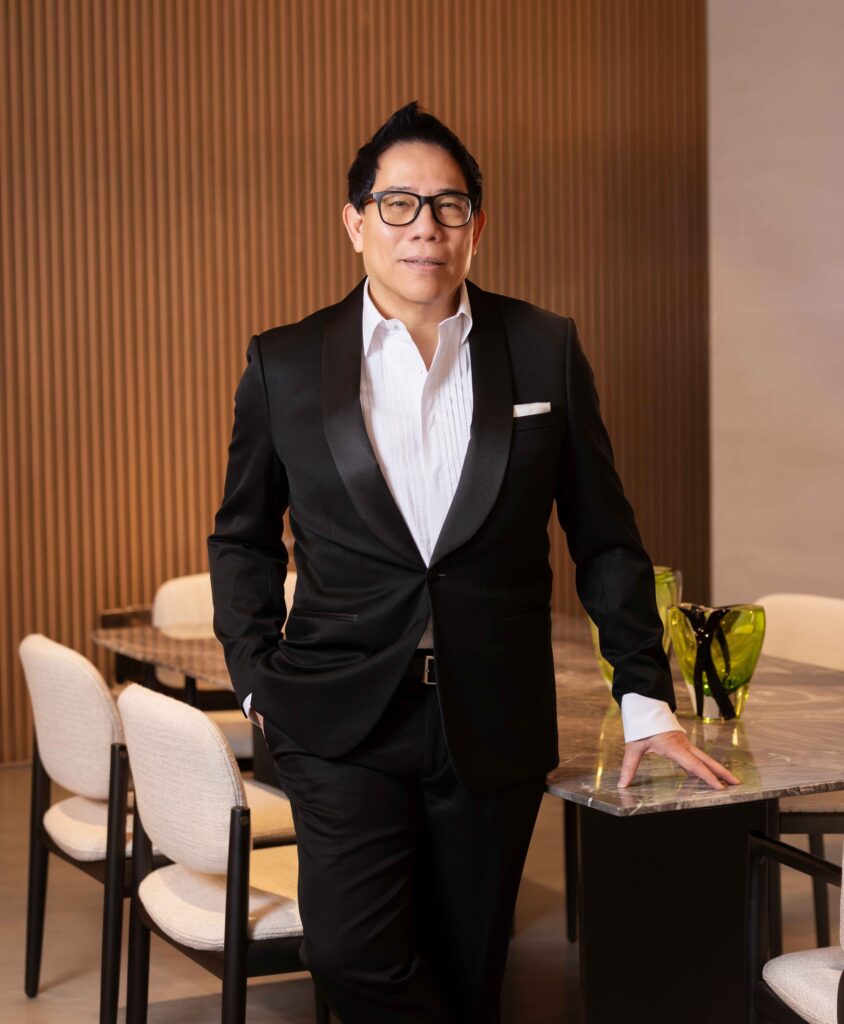
Joining the school Art Club in his first year, he discovered a love for capturing images, particularly through film photography. “Photography inspired me to pay attention to details, geometry, colour, and how light and shade interplay,” he explains. These foundational elements would later become the building blocks of his design philosophy – an eye for precision, harmony and aesthetic subtlety, rooted in his early artistic explorations.
Building Foundations

Luk’s initial ambition was to become an architect, a dream sparked by his fascination with cityscapes and buildings. “Photography probably played a role here, too,” he notes. “I was mesmerised by the imposing structures around the city; how they ‘spoke’ to each other and to the people.” He headed to the UK to study the subject.

To him, architecture is a form of art – large-scale, impactful and intimately connected to society. It is a dialogue between form and function, beauty and utility. His experience working on the design of the new Hong Kong International Airport in the 1990s further expanded this perspective. “Being involved from the very beginning was a huge catalyst,” says Luk, who returned to Hong Kong  to join the project. “It helped me understand how architecture can be both grand and human, technical yet poetic.”

Working alongside global experts in aviation design, he gained insights into how public architecture balances aesthetics with practicality. This experience laid the groundwork for his later pursuit of interior and lifestyle design – fields where he could bring art closer to people’s everyday lives.
High-flying Interiors

Post-Chek Lap Kok, Luk faced a pivotal decision: continue with large-scale projects or focus on something more personal? “I wanted to get ‘closer’ to the end-users,” he says of his shift towards intimate design. “Interior-design projects tend to be shorter in cycle and more directly impact people’s daily lives.”

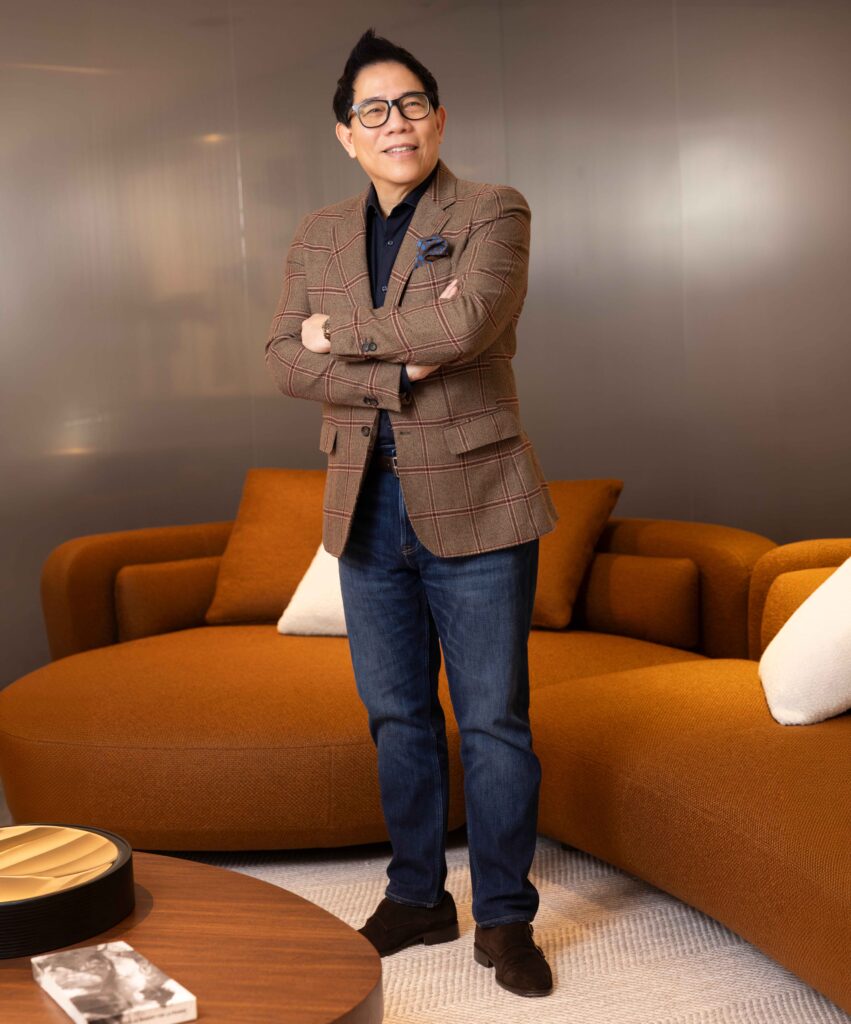
He began working with European furniture brands, notably Italian design company Minotti, which caught his eye for its blend of contemporary elegance and craftsmanship. He became the firm’s exclusive authorised dealer in Hong Kong and Macau, and Andante was born in 2004. A curated space where modern design meets sophisticated lifestyle, the flagship showroom spans two floors and 600 square metres. This inviting sanctuary is filled with carefully selected collections that embody Luk’s core philosophy of supreme quality, subtle style and timeless sophistication.

Located next door to Louvre Gallery, which was established in 1997, Andante has become a beacon of contemporary Italian and European design spanning furniture, lighting, home accessories and glass art. Beyond Minotti, it showcases names such as Venini, Bomma, Kose, SkLO, Tato, Nahoor, Venicem, Lumen Center, Purho, An&angel and Darmes.

Reflection of the Times

To Luk, “contemporary design” is more than just a style; it’s a reflection of the era. “It’s a time reference,” he explains. “Every period has its own contemporary expression. What was once ‘contemporary’ might eventually become ‘classical’ or ‘vintage’.” He believes that modern lifestyles – individualistic, flexible and urban – shape the evolution of design. “Contemporary design must mirror these lifestyles,” he says. “It should offer clean lines, quieter luxury, modest details and adaptability.”

He emphasises that art plays a vital role in interior spaces. “Historically, art was often an afterthought, something to ‘decorate’ walls at the end,” he notes. However, during the Covid pandemic, Luk rethought this approach. “Art should be integrated from the very beginning of the design process,” he declares. “In our Art Andante initiative, we now showcase how art can lead and inspire interior design, creating a complete ambience that is both aesthetic and emotional.”
Art in the Details

The concept of art as an integral part of design is central to Luk’s philosophy. “It’s about creating a dialogue between art and interior,” he explains. “Art doesn’t just decorate a space; it defines it.” This holistic perspective involves artworks, decorative items and furnishings curated to work in harmony, elevating the entire environment.

“During Covid, I realised that art could even lead the design concept,” he says. “Now, we aim for a 360-degree experience, where art is conceived alongside furniture and lighting, not just appended at the end.” This innovative approach has garnered appreciation from clients who seek spaces that are not only stylish but deeply meaningful, spaces that tell stories and evoke emotions.

A Style of His Own

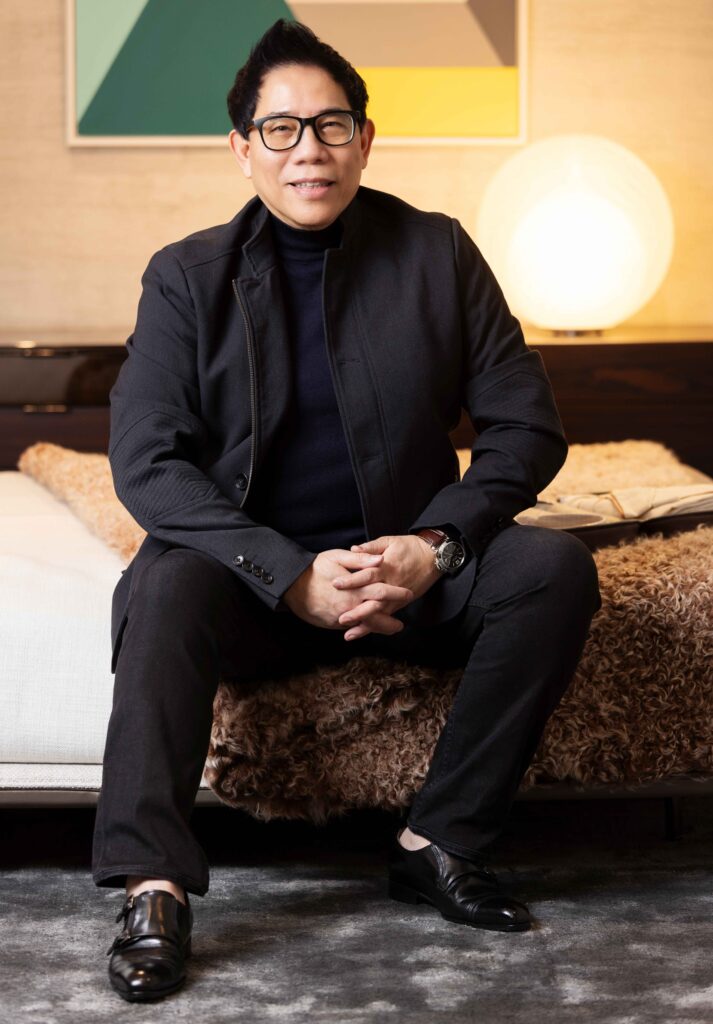
The personality of this accomplished photographer shines through as we photograph him. It’s apparent that he’s an easy-going boss and fun-loving entrepreneur, with a passion for the finer things in life “Is this Richard Gere enough for you?” he jokes, referencing the iconic Pretty Woman film poster as he poses for the camera. His staff cheer him on, proud of their leader’s vision and charisma.

His outfit is a testament to his refined taste and appreciation for elegance and quality. Designer pieces are carefully selected, down to the smallest details of the cufflinks he wears, and his wardrobe is impeccably coordinated.

Luk’s journey proves that passion, art and strategic thinking can transform into a thriving enterprise that elevates Hong Kong’s design scene. His story reminds us that behind every elegant space, there’s a person who believes in the power of beauty and the importance of craftsmanship, and a professional ethos that inspires sophistication and the artful pursuit of modern living.

Interview, Text & Art Direction: Joseff Musa     Photographer: Jack Law     Videographer: Iris Ventura  

Superb furniture company celebrates milestone  

Tony Luk explains why his furniture company remains a leader in the market and his insatiable appetite for photographing Hong Kong Ballet

Why did you want to become an architect and study in the UK?

I’ve always enjoyed design and modern art. Before I decided to study architecture, I already did a lot of photography of architecture. It was just a kind of fascination I had to see how come buildings can have this kind of power.

Architecture is a subject which combines science and art, combines history and contextual understanding of society. It’s actually quite an interesting subject whether one wants to be an architect or not.

The UK probably was a good first stop, due to the education system and the language, so it worked out to be the logical solution.

Following your early success in the UK and Hong Kong – did this give you confidence and what drove you to develop the top end European furniture & lighting sector in Hong Kong and set up the Louvre Gallery?

I had an opportunity to work in the airport project which at that time was one of the most advanced airport projects in the world. I came back to Hong Kong right away and then joined the airport team and it was still the site formation stage, the reclamation stage. It was a most exciting time as I was part of the planning of a project which basically involves all trades.

Following this success, I had a choice to make: do I go into architecture or do something which I can have a more hands-on control? When you do interior design projects, you’re much closer to the end user.

Around that time there were – like myself – quite a lot of overseas students returning to HK, and that new wave of demand for design lifestyle became quite prominent. Furthermore, because of the gradually maturing mindsets, the society demanded more and more of well-designed interior spaces for themselves.

I set up my first European furniture showroom in Hong Kong and embarked on catering to the luxury lifestyle market. I started to bring in some very avant-garde collections from Europe, mostly Italian. I was growing together with the market; I have to say, because in the 90s and 2000s, Hong Kong was becoming more and more mature with lifestyle.

I think we are much respected because we seem to be very consistent. It’s not about providing total utility. It’s more about how to nourish the mind and how to address people’s needs. I think after over some 25 years in the design and luxury lifestyle market, we may have become one of the key representatives in the market.

Why did you then decide to set up Andante and why did world-renowned Italian contemporary brand Minotti chose Andante to open their mono-brand showroom in HK? Do you share the same brand philosophy in creating furniture boutiques?

Around year 1997/98, a really elegant, beautiful and unique brand Minotti came to my attention. I spent quite a number of years to follow, connect and observe the development of this brand Minotti. Then came 2004, the relationship finally became very solid and we decided to start our collaboration with Minotti formally. It took some years to solidify the collaboration as Minotti was searching for a ‘partner’ and not merely a ‘dealer’. In April 2004, we decided to open a standalone mono-brand showroom – Minotti by Andante was founded in the Design Showcase within the important Ruttonjee Centre in the Central District of Hong Kong. Being a mono-brand showroom, we only had to focus on a certain sector of the market, so a ‘boutique’ concept was created.

I spent a few years following the design strategy of Minotti and noted clearly the consistency in the design DNA, new ideas were introduced and yet maintaining a timeless design approach – this idea of being ‘senza tempo’ as the Italians would put it.

Now we are no longer boutique. The brand is leading and we have to lead with them. We’re big enough to show the full strength of Minotti together with our own philosophy. It is a strong synergy between Minotti and Andante. Our society is a mixture of East and West – so should be the lifestyle, and so should be our showroom.

If we take the beautiful catalogues of Minotti, one can easily read the strong Minotti philosophy, we then introduce some of our own chosen art pieces, lighting and decorative items in order to bring some Andante context to the interior. We have our own character.

Andante celebrates its 20th anniversary this year – is its continued success down to ongoing appetite for both contemporary and modern classic design?

Contemporary design is surely the leading trend and way of living these days.

Poema (2024) Choreographer: Jirí Bubenícek, Dancers: Martina Arduino & Marco Agostino

‘Contemporary’ is a word to describe how the society embraces and accepts progress and changes. With respect to modern classic, it often co-exists with contemporary style; it is a ‘revival’ of some classic pieces but still keep the modernity in them. Many great designs didn’t grow from ‘zero’, it’s based on some classic design rudiments.

You suggest design and art are inseparable entities, both expressing emotions and telling stories. Is this the philosophy behind setting up Art | andante to curate art to complement designer furniture and décor?

Often design and art were considered very independent from each other, but in my opinion, these two elements are in fact inseparable. Art & design should really be considered as part of interior and architectural concepts. Therefore a few years ago, we decided to embark on the project ART I andante, as we would like interior design or spatial layout to have art in mind right from the start, instead of treating art as an aftermath. If the architect or end users like certain pieces of arts, why can’t the art to be the leading part of the design? For example, the colour or texture of the chosen art can be the centre point from which the interior / exterior design can work around.

Who are the artists and designers you have exclusive deals with and what are their signature artistic styles?

We are proud to represent a few Italian artists exclusively, they are Matteo Negri, Alessio Ceruti, Federico Casati and Eugenio Filippi, interestingly enough, most of them have their own professions apart from being artists.

Renato & Roberto Minotti at the grand opening of Minotti by Andante, 2004

Federico, for instance, is a photographer, a teacher and an artist. His work is actually a very monochrome art. The essential attribute of Federico’s art is the mutability: according to the intensity and angles of the light that casts on the metallic elements, the composition may change continually. You see the shadows, which are the parts which you cannot touch, but it’s the part that attracts your attention.

Now, one thing which is important about all of these artists would be the fact that they can do installation art. Again, the art could be a dominating part of the space.

What are the biggest challenges you have had to overcome professionally?

It’s a challenging position to be in a commercial situation because you have to always fight between will it sell, will it make money, or does it satisfy my own belief?

And once you have it, if you move too fast, you lose money, you lose face. You have to reassess; you have to bring yourself closer to the market without losing yourself. It’s a strange thing, these challenges. I am still facing it, by the way.

Is the competitive landscape becoming increasingly crowded in Hong Kong for architects and designers?

I think any market with potential will always have competitors. It’s not a new thing.

Professional competitors would be people who work in a very professional way to promote, to launch, to display and to work in what they believe in.

Mr & Mrs Shroff of the Ruttonjee Centre at the grand opening of Minotti by Andante, 2004

And the nonprofessional ones are copiers of what these professional people are doing and trying to steal from them. A very typical situation will be parallel importers.

But in the Ruttonjee Centre, in general, people are professional. Here, you work almost like a collaborator in creating a more complete design scene.

Do you have any comments on moves to create more sustainable products?

The key element here is that the design has to be sustainable, not just whether it is biodegradable or not. This is what we mean when we talk about timeless design. Timeless design means people would like to keep it.

Furthermore, the quality of production has to be strong enough that you can sit on this chair for ten years without it flailing badly or the cushion dipping inside. This to me is the sustainability in our industry.

Do you have any personal passions which have enriched your life?

Photography enriches my life definitely. It’s a hobby; you could say it’s a passion. The pleasure is capturing something I would like to capture. I don’t have to worry about selling or not selling, although luckily, I have collectors.

I’m lucky because it’s just a hobby, turned passion, turned sharing.

As a keen photographer, what specifically appeals about the Hong Kong Ballet enough to become its Honorary Photographer?

I’ve been photographing Hong Kong Ballet for 30 years. I have the biggest archive, and I’m very pleased to be part of it. I donate every single penny and more back to the Hong Kong Ballet from any pictures that I sell.

Turandot (2015) Choreographer: Natalie Weir, Dancers: Liu Miao-miao.
Courtesy of HK Ballet

The excitement about stage photography of ballet is that one just does not know what comes next onto the stage, there might be one or multiple dancers all jumping onto the stage at the same time. So subsequently, it’s a strange thing, and it’s because of this uncertainty that it’s a bit of a drug for you. As much as I can, I try to cover at least the main dancers, the different casts.

But the aesthetics are wonderful. I love photographing people, and my editing is very much into focusing on the person.

Do you have any future plans and ambitions?

The future plan is to hopefully make more people happy, enjoy living in certain environments and become themselves, their own designers. I hope I could inspire them to express their own design flair and their own needs so that they could become their own master of their own design, their own environment.