

Flower Fortune: Blooms bursting with symbolism energise Hong Kong ahead of Lunar New Year

There are a few happenings in Hong Kong’s cultural calendar, as cherished as the Chinese New Year flower market. Long before the first lion-dance drumroll echoes through the streets or families gather for their reunion dinners, the city begins an enchanting, colour-soaked transformation. The tradition begins quietly, almost imperceptibly, as flower-growers arrive with trucks filled to the brim with peach blossoms, orchids, peonies, chrysanthemums, narcissi, kumquat trees and more. Then, overnight, a local park or open space metamorphoses into one of the Spring Festival’s most joyful and beautifully chaotic rituals.

In Hong Kong, the Lunar New Year flower market is not merely a place to shop for festive blooms ahead of the three-day holiday. It is an annual cultural pilgrimage where heritage, aesthetics, community, superstition and celebration meet. Above all, it is where locals venture to set the emotional tone for the year ahead.

As each New Year’s festival approaches, a subtle shift takes hold across the city. Supermarkets begin stacking up mandarin oranges wrapped in red netting and bakeries start piping auspicious characters onto buns. But it is at the annual flower markets that the atmosphere feels most electric.

Victoria Park’s Lunar New Year Fair is the most iconic of them all. When it opens a week before the holiday, the city starts to celebrate. Every year, the transition from leafy leisure area to bustling market is almost magical. Stalls arise to form brightly coloured pop-up villages. Lights are strung across canopies. Families arrive early, flooding the aisles as flower-sellers call out good-luck greetings. Young couples wander around taking photos. Children run back and forth excitedly, pointing at tiny citrus trees and racks of plush toys. There is an unmistakable hum of shared anticipation as the old year gives way to the new.

Blooming Marvels

Choosing flowers for the occasion is not merely a decorative preference. Each bloom is carefully selected for the symbolism it unfurls over the Chinese New Year. Peach blossoms evoke love and harmony; orchids represent refinement, integrity and quiet prosperity; peonies signal wealth and honour; and chrysanthemums conjure longevity. Narcissi and gladioli are believed to usher in good fortune if they bloom at the right moment. Kumquat trees, with their tiny golden-orange fruit, are purchased for their association with abundance.

But symbolism is only part of the story. Hong Kong also appreciates the aesthetic beauty of welcoming the New Year with fresh blooms. Red, gold, fuchsia, pale pink, white, jade green – the palette is vivid. In homes large and small, in hotels, in restaurants, in private members’ clubs, these festive flowers set an inviting ambience. They soften the winter chill, fill interiors with light and optimism, and reconnect urbanites with nature in this hectic metropolis.

Aroma Nostalgia

Most people have at least one cherished memory tied to Victoria Park’s flower fair. Some recall coming as children, clutching red lai-see envelopes from relatives. Others remember choosing their first kumquat tree for their marital home. And some simply love the energy of families, elders and teenagers all mingling together under the same glowing lights.

The market layout shifts slightly each year, but its character remains consistent: aisles bursting with blooms, stallholders who have been participating for decades, and a crowd that swells in increasingly great numbers as the holiday approaches. Mornings are gentler – perfect for those who want to examine orchid stems in peace – while evenings are thrilling congregations of fragrance and noise. For many Hong Kongers, the build-up to Chinese New Year isn’t complete without a late-night wander among the animated Victoria Park crowds.

While Victoria Park is the grand celebration, neighbourhood flower markets offer a more intimate charm. Mong Kok’s flower market in Prince Edward Road is vibrant year-round, but during the lead-up to the New Year, it becomes spectacular. Peonies spill out of buckets in jewel tones. Stems of pussy willow, which are considered lucky, line storefronts like vertical sculptures. Rare orchid hybrids are displayed prominently for the city’s most discerning buyers.

In Sha Tin, Yuen Long and Tuen Mun, the flower fairs have a more local vibe. These are the markets where families return to the same stallholder year after year. Growers greet regular customers by name and freely offer advice – how to keep a kumquat tree thriving indoors; how many stalks of lucky bamboo should be placed in a vase; how to encourage a narcissus bulb to bloom exactly on New Year’s Day. The atmosphere is intimate and grounded, a reminder that the Lunar New Year spirit is as much about community as celebration.

Ritual Revels

Buying flowers for the Chinese New Year is partly aesthetic, partly cultural and partly instinctive. Some choose based on long-standing family traditions; others select according to colour palettes or interior design. Many residents simply walk the market aisles until something speaks to them – an orchid in a shade they’ve never seen before; a peach blossom branch with particularly elegant curves; a narcissus bulb showing promising shoots.

Stallholders are an integral part of the festivities. They tap branches gently to reveal hidden buds, demonstrating which will bloom at the right moment. They know which orchids will last longest if the weather is humid, which citrus plants will hold their fruit, and which colours carry the most auspicious meanings for the year ahead.

In a city known for its speed and ambition, the flower-market ritual does something meaningful: it slows life down. If only for a few days, residents pause, breathe, appreciate beauty, and reconnect with traditions as old as the Fragrant Harbour itself. Among the blossoms, the bustle and the laughter comes the fragrance of a thousand hopeful beginnings, as Hong Kong in all its glorious vibrancy steps confidently into a new year.
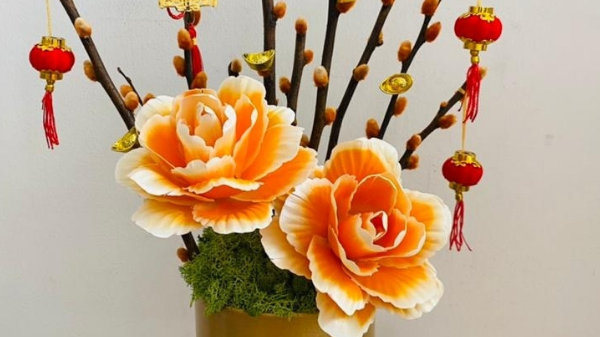
Stem Sells: Which Chinese New Year flowers should you buy to grace your bowers?

While the winter season may seem a somewhat contrary time to turn your mind to matters floral, it’s actually a peak purchasing time for Hongkongers. Every year, at around this time, tens of thousands of petal-minded purchasers descend upon the annual Lunar New Year Fair – also known as the Lunar New Year Flower Market – in search of the perfect festive flowers to gift their loved ones. 

gafencu magazine gmhk local feature Stem Sells Which Chinese New Year flowers should you buy to grace your bowers

This year, in spite of social distancing measures and the downbeat sentiment triggered by the on-going coronavirus pandemic, the government green-lit the fair – albeit at half capacity. As such, from the 6th to 12th of February, 15 locations across Hong Kong will serve as the venues for this year’s offering, with Causeway Bay’s Victoria Park and Fa Hui Park in Mong Kok set to welcome the bulk of the hundreds of vendors and the thousands of visitors expected to participate in this seven-day garland gala. 

gafencu magazine gmhk local feature Stem Sells Which Chinese New Year flowers should you buy to grace your bowers orchids

Many Hongkongers will have already decided exactly which plants they plan on taking on, whether that’s ornate orchids, pulchritudinous peach blossoms or luxuriant lucky bamboo plants. What most may not be aware of, however, is why these particular blooms are especially sought out during the Spring Festival. If you are one of the many yet to be fully conversant with the arcane arts of floriography – the official term for deciphering the language and symbolism of flowers – fear not. Join us on a tour through the A-to-Z of the most auspicious CNY blooms, highlighting what they symbolise and advising how you can best avoid any inappropriate gift-giving gaffes.  

gafencu magazine gmhk local feature Stem Sells Which Chinese New Year flowers should you buy to grace your bowers orchids -1

Orchids

The diverse family of flowering plants known colloquially as orchids encompasses a staggering 28,000 varietals. Varying in shapes, hues and sizes, these tropical blossoms are among the most popular festive adornments to be seen throughout the Chinese New Year celebrations. Said to symbolise abundance, fertility, refinement and luxury, orchids are ideal gifts for that special someone in your life. There’s a common misconception that only multiple varieties make an acceptable gift, when, in fact, sticking to just one potted plant will often more than suffice. 

gafencu magazine gmhk local feature Stem Sells Which Chinese New Year flowers should you buy to grace your bowers peach blossoms

Peach Blossoms

Peach blossoms have long been prized in Chinese culture. In fact, during times more classical, it was believed that the peach tree embodied more vitality than any other shrub, largely because its flowers bloomed even before its leaves began to sprout. As such, peach blossom branches were once hung over doorways as a means of warding off evil influences. Today, they are still seen as promoting long life and prosperity, as well as romance. So, if you’re single and looking to mingle, there’s no harm in grabbing a bushel of these blushing blossoms.

gafencu magazine gmhk local feature Stem Sells Which Chinese New Year flowers should you buy to grace your bowers pussy willow

Pussy Willows

Unlike their petaled cousins, pussy willows boast uniquely fluffy and silky blossoms, attributes that in no way diminish their Spring Festival appeal. As their buds eventually spawn shoots the colour of green jade – a substance considered by the Chinese to be particularly fortuitous – pussy willows are believed to help usher in prosperity and growth. Although only naturally occurring in white, intrepid growers have developed dyed versions that range from brown and gold to pink and even a lucky red. 

gafencu magazine gmhk local feature Stem Sells Which Chinese New Year flowers should you buy to grace your bowers Narcissus -2

Narcissus

Although in Greek mythology the story of Narcissus is somewhat bleak – with his namesake blooms springing up after the demigod in question withered away after falling in love with his own reflection in a pool – in Oriental tradition, they actually rank among the most auspicious of Chinese New Year flowers. Delicate and deliciously fragrant, they betoken good fortune and prosperity in the year to come. Also known as ‘Water Fairy Flowers’ or ‘Chinese Sacred Lilies’, they have a relatively short lifespan, so it’s best to buy them close to the start of the Lunar New Year Fair in order to ensure they last throughout the celebrations. 

gafencu magazine gmhk local feature Stem Sells Which Chinese New Year flowers should you buy to grace your bowers gladiolus

Gladiolus

According to Western traditions, gladioli are the birth flowers of those born in the month of August, as well as the traditional blooms associated with a 40th wedding anniversary. In Chinese culture, however, they symbolise advancements in personal development as well as career growth, a belief stemming from the upright shape of the flower from base to tip. Although gladioli are available in a rainbow of stunning colours, the best way to capture the festive spirit is to opt for a mono-hued red whether you’re buying a single branch or an entire bouquet. 

gafencu magazine gmhk local feature Stem Sells Which Chinese New Year flowers should you buy to grace your bowers peonies

Peonies

Among the flora with the greatest heritage of use in East Asia, the peony was actually declared the national flower during China’s Qing Dynasty (1636-1912) and remains a much-favoured Lunar New Year adornment. Emblemising feminine beauty, innocence, charm and affection, they will likely be doubly in vogue this coming Year of the Ox as the Spring Festival coincides with Valentine’s Day. If you’re looking to woo the lucky lady in your life, a bouquet of peonies is pretty much your best bet. 

gafencu magazine gmhk local feature Stem Sells Which Chinese New Year flowers should you buy to grace your bowers lucky bamboo

Lucky Bamboo

Lucky bamboo plants may crop up in offices and homes throughout the year, but they are especially popular during the Spring Festival thanks to their status as good luck charms. The majority of lucky bamboo plants today are grown and exported from either Taiwan or China, where professionally trained growers skilfully braid, twist or shape their stems into intricate patterns. While they are resilient and long-lived, experts recommend watering them with bottled or distilled water as the chlorine and chemicals found in tap water can be detrimental to their wellbeing. 

gafencu magazine gmhk local feature Stem Sells Which Chinese New Year flowers should you buy to grace your bowers tangerine mandarin orange tree

Fruits

No Chinese New Year celebration would be complete without the requisite gifts of fruits. In particular, mandarins and tangerines are much-loved favourites and can usually be seen everywhere throughout the holiday. This may be due to the fact that the Chinese word for mandarins sounds similar to those for luck and good fortune. Tangerine plants, meanwhile, can often be spotted near doorways as they are thought to bequeath good luck on those stepping to and fro. 

Another citrus fruit, the pomelo, similarly imparts good fortune. With its Mandarin name serving as a homophone for the words that mean “prayer for a son”, it also doubles as a symbol for family unity and fertility.