

Ghentish Charm: Meandering waterways, cobblestone streets and medieval architecture, this Belgian city has it all.

To say that Belgium has more than its fair share of iconic cities is something of an understatement. After all, the tiny 11.46 million-strong nation boasts such notables as Brussels, home of the European Parliament, Bruges, the picturesque town dubbed the “Venice of the North”, and Antwerp, long the country’s historic diamond and Art Deco hotspot. However, few would call to mind Ghent, the Northern Belgian city that encompasses the most historical classified buildings in the country, including three monuments listed as UNESCO World Heritage Sites.

Ghentish Charm Meandering waterways, cobblestone streets and medieval architecture, this Belgian city has it all Gafencu Magazine Travel (4)
The second largest city in the Flemish region of Belgium, Ghent is home to just under 250,000 souls, yet it attracts millions of tourists each year, many drawn by its vibrant art, history and architectural charm. Although the area was first settled during the Stone Age, it wasn’t until 650 AD, when Saint Armand, a bishop of Tongeren-Maastricht and a renowned Flemish missionary, founded two abbeys at Ghent when the town truly flourished. By the 13th century, it had grown to such an extent that it was the biggest European city after Paris, overtaking such cosmopolitan hubs as Moscow and Cologne. By the Renaissance Era, thanks to a booming wool trade,  the town had transformed into one of the richest cities on the European continent.

Ghentish Charm Meandering waterways, cobblestone streets and medieval architecture, this Belgian city has it all Gafencu Magazine Travel streets
Today, Ghent is just a 45-minute train ride from Brussels, the Belgian capital. Boasting beautiful castles, glistening canals, intriguing architecture and a plethora of culinary delights, there is truly plenty to see and do in this port city. If you’re looking for a place to base your sightseeing, the city’s gothic splendour has been channelled expertly into what was the old post office, right on the city’s famous mediaeval quay, the Graslei.

Ghentish Charm Meandering waterways, cobblestone streets and medieval architecture, this Belgian city has it all Gafencu Magazine Travel activities

1898 The Post is a brooding boutique hotel bristling with fairytale turrets and tall windows overlooking the canal. Postal paraphernalia such as writing bureaus and antique pencil cases can be found in the hallways and deliciously dark-walled rooms – all of it reassuringly kitsch-free. Socialise over cocktails in the Cobbler or fix a drink and settle in with some Edgar Allan Poe in the turret-set honesty bar, replete with rows of leather-bound tomes and stag beetles in glass cases.

Ghentish Charm Meandering waterways, cobblestone streets and medieval architecture, this Belgian city has it all Gafencu Magazine Travel (3)
Once you’re ready to begin your explorations in earnest, a good place to start would be the Gravensteen castle. Built in 1180, it was subsequently re-purposed as a court, prison, mint, and even as a cotton factory. It was restored over 1893–1903 and is now a museum and a major landmark in the city. Its latest iteration houses the Arms Museum and the Museum of Judicial Objects, allowing intrepid visitors a first-hand glimpse at the weapons and torture devices used in medieval times. Make sure to visit the rooftop of this stone fortress, for the 360-degree views to be had which are are some of the most picture-worthy in Ghent.

Ghentish Charm Meandering waterways, cobblestone streets and medieval architecture, this Belgian city has it all Gafencu Magazine Travel landmark tower chappel
Another historic monument worthy of a stopover is St Bavo’s Cathedral, an 11th century religious structure where Charles V, the Holy Roman Emperor was baptised. Here you’ll find the Adoration of the Mystic Lamb altarpiece, a stunning relic painted by such great masters as Hubert and Jan van Eyck in the 15th century. For more picturesque vistas, head over to the iconic Ghent Belfry, a stunning 91m-high structure listed as a UNESCO World Heritage Site. The tallest belfry in the country, its magnificent gothic architecture is awe-inspiring to behold, replete with copper dragon that has been guarding the city since the 14th century.

Ghentish Charm Meandering waterways, cobblestone streets and medieval architecture, this Belgian city has it all Gafencu Magazine Travel (1)
Meanwhile, art lovers could do far worse than to venture to DOK, a temporary cultural project in a large area where the old harbour and the border of the city flow into each other – empty warehouses, some slightly out-of-place apartment blocks and the odd second-hand car dealer. Together with DOK neighbourhood residents and local artists, it promotes arts, culture and sports initiatives … It even had a row-in cinema, where everyone was watching Jaws on small boats in front of a big screen on the water. Art hub Democracy, meanwhile, takes care of the live music shows, and you can also find SECONDROOM Ghent there, a gallery concept where cutting edge contemporary artists show their work.

“Millions of tourists are lured  to Ghent by its vibrant art, history and architecture” 

Ghent also has a vibrant street art scene, featuring the likes of artist Bue the Warrior and his joyous, colourful creatures, and the enigmatic Roa with his dark, black-and-white animals. Their work can be seen on walls all over town, often in collaboration with other less well-known painters. One particular wall, at the junction of Sleepstraat, Grauwpoort and Rodelijvekensstraat, marks the location where almost all the Ghent street kings have made a big tableau together and is a fantastic Instagram spot, should you wish to click a picture.

Ghentish Charm Meandering waterways, cobblestone streets and medieval architecture, this Belgian city has it all Gafencu Magazine Travel (2)
If you’re understandably hungry after all that sightseeing, fear not, for Ghent boasts plenty of signature dishes to fill your stomach and soul. In the city and other East Flanders areas, many bakeries offer a donut-shaped bun called a “mastel”, which is basically akin to a bagel. Mastellen are also called “Saint Hubert bread”, because on the Saint’s feast day, which is 3 November, the bakers bring their batches to early Mass to be blessed.

Ghentish Charm Meandering waterways, cobblestone streets and medieval architecture, this Belgian city has it all Gafencu Magazine Travel
Other local delicacies are the praline chocolates from famous local chocolatiers such as Leonidas, the cuberdons or ‘neuzekes’ (‘noses’), cone-shaped purple jelly-filled candies, ‘babelutten’ (‘babblers’), hard butterscotch-like candy, and of course, on the more fiery side, the famous ‘Tierenteyn’, a hot but refined mustard that has some affinity to French ‘Dijon’ mustard and is sure to have your taste buds tingling.

Ghentish Charm Meandering waterways, cobblestone streets and medieval architecture, this Belgian city has it all Gafencu Magazine Travel food
Stoverij, a classic Flemish meat stew, is another dish you can’t miss. Preferably made with a generous addition of brown Trappist beer and served with French fries, it offers a wholesome, filling dish to satiate your hunger. Waterzooi is another local stew to try, originally made from freshwater fish caught in the rivers and creeks of Ghent, but nowadays often made with chicken instead of fish. It is usually served nouvelle-cuisine-style, and offers a lighter alternative to the stoverij.

“Many jetsetters have been entranced by Ghent’s unique past-meets-present charm”

Of course, no visit to Ghent would be complete without a pint or two of the famed local Belgian beers. In particular, the Trappist beers, brewed to this day by abbey monks, is a must-have. From stunning medieval castles, awe-inspiring Gothic architecture, and quaint cobbled streets to the vibrant art and culinary hotspots that punctuate this Belgian city, Ghent is a place that continues to celebrate its unique history, while still having its eye firmly on modernity. This unique past-meets-present charm is exactly why Ghent has entranced so many jetsetters over the years. 
Bruges: A potted history of Belgium’s best-kept secret

For many, Bruges, the largest city in northwest Belgium, may be most familiar as the setting for the film that shares its name, In Bruges, a 2008 espionage comedy. What all but the most well-heeled world-wanderers may be unaware of, however, is that this truly magnificent mini-metropolis deserves star billing in its own right.

The canalways of Bruges

Set a mere hour’s train ride from Brussels, the Belgian capital, Bruges is home to just 117,000 permanent residents. Its low local count, however, has done nothing to stop this splendidly verdant locale from punching well above its weight when it comes to inbound tourists, millions of whom throng the picturesque city every year.

Undeniably quaint, Bruges lies at the heart of the country’s Flemish-speaking region. The site has been settled, in one form or another, since the Bronze Age, but it wasn’t until the early Middle Ages (around 9AD) that the Vikings paved the way for what we now know as Bruges. Indeed, its very name is said to be derived from brygga, the ancient Scandinavian term for ‘harbour’.

Bruges from Belfry Tower

It’s a more-than-apt designation. Thanks to its strategic North Sea setting, subsequent centuries saw Bruges enjoy something of a Golden Age as a key trade hub and a hugely influential cultural centre. It was not to last, however. By the end of the 13th century, Zwin – the tidal inlet linking Bruges to the North Sea – dried up, dooming the city to centuries of economic obscurity.

It was only after the two World Wars, when Bruges – and its countless historic monuments – remained mostly unscathed despite the ravages of war that it came to establish itself as one of Europe’s pre-eminent tourism hubs.

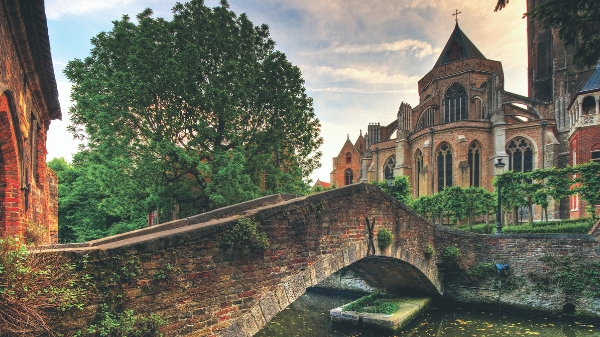
Bridge to The Church of Our Lady

Today, Bruges’s historic centre – now designated a UNESCO World Heritage site – retains the quaint charm and architectural heritage of its Golden Age. In fact, it remains one of the best-preserved examples of a medieval town in Europe, effortlessly transporting visitors to the days when its bustling cobblestone paths and crisscrossing canalways were thronged with merchants and artists.

Any visit to Bruges should begin at the centrally-located Market Square. Start on a literal high note by heading to the Belfry Tower, the most iconic site in the whole town. Built around 1240, the medieval bell tower remains standing having withstood a succession of potentially devastating fires. Its tolling bells have long been a Bruges staple. At 83m in height, visitors can (and should) pay the relatively low entrance fee and venture up the 366 steps to the peak, where the sweeping panoramic views make the climb well worth it.

Gruuthusemuseum

For a truly immersive approach, stop by the neighbouring Historium museum. Here, visitors can indulge in a little high-tech magic and virtually transport themselves back to the city’s medieval heyday. Next, head to the Gruuthusemuseum, just 5 minutes walk away. Once home to an affluent and prominent 13th-century family, this well-preserved building has been reinvented as a showcase for the city’s archeological heritage. Handily, a chapel added to the original structure in 1472 actually connects to another of Bruges’ landmarks – the Church of Our Lady.

Dating back to the 13th century, this particular place of worship remains the city’s tallest structure and, at 115.6m in height, it is also the second-tallest brickwork tower anywhere in the world. While it is also said to the final resting place of Charles the Bold, the last Valois Duke of Burgundy, it’s true claim to fame is its altarpiece – a stunning white marble sculpture of Madonna and Child created by the great Italian artist, Michelangelo and the only sculpture to leave his home country during his lifetime.

Tomb of Charles the Bold, The Church of Our Lady

Another must-see holy site is the Basilica of the Holy Blood. This Gothic structure encompasses two wholly separate chapels – an austere Romanesque chapel underneath (dedicated to St Basil the Great [330-379AD]) and a flamboyant 16th-century Gothic upper level, said to house an actual sample of Jesus’ blood, a truly venerable relic for religious pilgrims.

Art aficionados, meanwhile, could head instead to the Groeningemuseum, a repository of many of the country’s artistic masterpieces, including much admired works by such classic luminaries as Jan van Eyck (1390-1441), as well as more contemporary creators, notably Marcel Broodhaers (1924-1976).

Fine-dining fare at Zet’Joe

Despite the many monuments jostling for your attention, make sure to set aside enough time to explore another of Bruges’ undeniable attractions – its verdant landscape. Unlike many urban cities, this stunning regional capital retains a truly tranquil aura, thanks to its lush greenery. The most spectacular example is the Minnewaterpark, which hugs the historic centre’s southern boundaries. Another fantastic way to take in the natural attractions is to hop aboard one of the countless canal boats, allowing you to gain a wholly new perspective on this historic town.

If you’re left somewhat ravenous after all that exploration, fear not for Bruges also boasts a truly bustling dining scene. Those in need of fine-dining fare, for instance, could do worse than explore the one Michelin-starred Zet’Joe by Geert van Hecke, an establishment that serves sumptuous contemporary Belgian cuisine.

The aptly-famous Belgian beer

Finally, what better way to round off your trip to Bruges than by quaffing some of its renowned Belgian beers. Thankfully, dozens of tiny pubs and bars ring the roads surrounding the central Market Square, including the Instagram-famous The Beer Wall, replete with an actual wall-sized display of beer bottles. If you visit the establishment, ask for a Westvleteren 12, a rare ale brewed in limited quantities by Belgium’s famously unverbose Trappists. Prost – as they almost certainly don’t say…

Text: Tenzing Thondup

In Bruges: Four reasons to visit the picturesque Belgian town

For most, the Belgian town of Bruges may be most familiar as the setting for the 2008 action thriller In Bruges, starring Colin Farrell, Ralph Fiennes and Brendan Gleeson. But what all but the most well-heeled traveller may be unaware of is that this tiny village is actually a star in its own right.

What to see and do in Bruges

Despite having a population of just 117,000 permanent residents, this verdant city punches well over its weight in tourism figures. In 2017 alone, it drew over 16 million visitors, a number that represents the culmination of Bruges’ ever-increasing must-see-ability on the part of eager explorers around the world. It’s also a whopping 50 percent increase from the number of in-bound travellers just five years previously (11.8 million).

So what, exactly, is enticing these millions of Belgian-bound tourists to make the two-hour excursion outside of its capital city Brussels? Well, these four reasons may have something to do with it…

The Belfry Tower is an iconic Bruges landmark

Historic monuments

Bruges’ history dates all the way back to the 9th century, when it was first founded by roving Vikings. Intervening centuries saw it grow into a important trade hub and financial centre. A happy by-product of this legacy is the countless well-preserved historical monuments that punctuate the city’s acreage.

Perhaps the most famous of these is the Belfry Tower, perfectly positioned in the Historic Centre of Bruges, a recognised UNESCO World Heritage Site. Another must-see site is the neighbouring Historium museum, which allows visitors a 3D flashback to the city’s Golden Age (12th – 15th centuries).

Minnewaterpark offers verdant greenery and even a Lake of Love

Verdant greenery

Unlike most urban cities, Bruges retains a tranquil aura thanks, in large part, to the high percentage of greenery that can be found within its boundaries. The most spectacular example of this is the Minnewaterpark, which hugs its southern walls. Those seeking a bit of romance should definitely meander along the rectangular lake here, appropriately dubbed the ‘Lake of Love’.

If you visit Bruges, drop by The Beer Wall for some rare brews
If you visit Bruges, drop by The Beer Wall for some rare Belgian brews

Beer

Belgian beers are amongst the most sought after in the world, a fact that local Bruges denizens have been keen to take advantage of. Dozens of tiny pubs and bars ring the roads surrounding the central Market area, including the Instagram-famous The Beer Wall, replete with an actual wall-sized display of beer bottles. If you visit the establishment, ask for a Westvleteren 12, a rare ale brewed in limited quantities by Trappist monks.

Ancient canals and bridges dot the Bruge landscape
Ancient canals and bridges dot the Bruges landscape

Canals and bridges

Much like Venice, Bruges boasts countless canalways and medieval bridges that criss-cross its landscape. Hop aboard one of the manycanal boats to gain a new perspective on this historic town. After all, these waterways were once at the heart of the city’s maritime trade network.

Text: Tenzing Thondup