
Sarah Heller: Asia’s youngest Master of Wine and what she’s currently drinking

Sarah Heller discusses becoming Asia’s youngest Master of Wine, the evolution of Hong Kong’s wine industry and the vineyards she currently has her eye on…


Your wine career had something of a bumpy start…

A little bit, yes. After graduating from university, I had a job lined up with an Italian wine importer and they very generously sent me to tour a few Italian wineries over the summer. Unfortunately, part way through my first visit, I fell into a wine vat and fractured my spine, which was – in equal parts – mortifying and painful. So rather than start working, I had to return to Hong Kong for a prolonged period of rehabilitation.

When I arrived, the city had just cut all duty on wine, so the local wine market was exploding, while the US scene had become rather stagnant in the wake of the Global Financial Crisis. It became clear that I should stay in Hong Kong and I began working for Debra Meiburg, one of the first Masters of Wine in Asia, and she really encouraged me to pursue my academic interests in wine. I’ve always been a little bit of a geek, so when I realised there was an academic qualification in wine – the Master of Wine certification – I just knew I had to go for it.

Sarah Heller is Asia's youngest Master of Wine

As Asia’s youngest Master of Wine (MW), what can you tell us about this particular qualification

Well, strictly speaking, the MW isn’t an academic qualification at all. It’s more like a guild, but one that requires a lot of study, hard work and success in several examinations if you want to become a member. As an institute, it was formed in 1953 as an offshoot of the Vintner’s Guild. Essentially, the MW is seen as official confirmation that its owner is particularly knowledgeable when it comes to all things wine-related.

Sarah Heller discovered her passion for wine in Italy

How has Hong Kong’s wine market evolved over the 10 years you’ve been involved here?

Well, many things have changed. When Hong Kong first opened up and set about becoming Asia’s wine hub, the focus was almost exclusively on the fine wine segment and, in particular, on a tiny group of high-end producers in Bordeaux. Today, there’s far more diversity. While it’s still driven primarily by collectors, other sectors of the market have expanded considerably.

The food and beverage industry, for example, has become far more vibrant as things have progressed. Beyond that, there’s also an emerging group of younger collectors who have driven the move towards Burgundy, while also highlighting some of the once-lesser-known wine-producing regions, so it’s been an exciting time to watch the evolution of local wine preferences.

Have there been any particular regions that you have seen coming to the fore of late?

I think Italy has really been the one that’s proved something of a rising star over the last two years. I’m on the committee of an association called the Hong Kong Wine Society, and we’ve noticed a massive increase in interest in tastings of Italian wines, particularly prime Piedmontese varietals, such as Barbaresco or Barolo. In many ways, the Tuscan vintages are akin to Bordeaux, while Piedmonte is closer to Burgundy.

Sarah Heller is multilingual and speaks six languages

What projects are currently occupying you?

Actually, although I’m now an MW, I don’t have a regular nine-to-five schedule as everything I do is project-based. Wine education has been a big part of my career and I’ve long been involved with the Vinitaly International Academy – an Italian wine education institute – as a visiting lecturer. I’ve also designed a range of crystal glassware in partnership with Lucaris, a Thai crystal company. This will launch in November and has been crafted while keeping in mind the unique way Asian consumers enjoy food and wine.

Aside from that, I’m also collaborating on creating a new wine brand with a couple of partners – one is an Austrian wine producer and the other an Austro-Hungarian noble. This particular project came about as a way of introducing Austrian wines to the Asia market, but the project has now expanded to encompass all the wineries of Central Europe. We just launched in Hong Kong, Japan, Thailand and Vietnam and will shortly be in Poland and Sweden. We’re also hoping to produce a documentary that will chart the whole process of creating these wines sometime next year. Watch this space…

Sarah Heller is involved with many exciting wine education projects

Are there any new wines that have recently caught your eye?

I think sparkling wines worldwide have become so much more interesting over recent years. While the French champagnes are, of course, delicious, it’s invigorating to see new players coming up. Right now, I’m particularly enamoured with Franciacorte – from the northern Italian province of Brescia – that produces such sparkling wines as Ca’ del Bosco and Bellavista. While champagnes can be compared to super-skinny supermodels, these are more like Sophia Loren – full-bodied, softer and warmer. Aside from that, I’m partial to a drop of Nyetimer or Rathfinny, both of which are English wineries.

Thank you.

Interview by: Tenzing Thondup
Photos: Jack Law
Art Direction: San Wong
Make-up: Margaret Wong
Venue: The Optimist
 

Veuve Clicquot launches La Grande Dame 2008 in Hong Kong

Veuve Clicquot, the renowned French champagne brand, is no stranger to innovation. In fact, it’s has been an inherent part of the maison’s DNA ever since Madame Barbe-Nicole Clicquot Ponsardin, an intrepid businesswoman, first took over the company’s reins after her husband’s passing back in 1805 and became known within oenologist circles as La Grande Dame of Champagne.

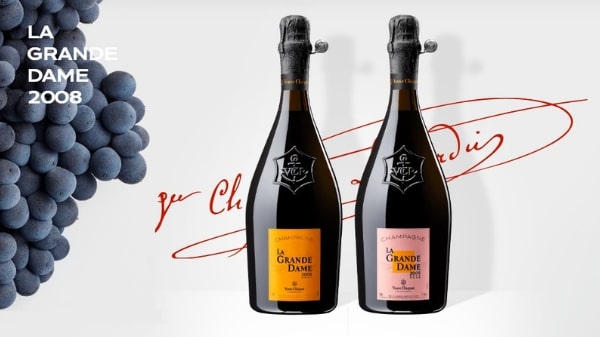
Veuve Clicquot La Grande Dame 2008 champagnes

To pay homage to this avant-garde female entrepreneur, back in 1972 – coincidentally the label’s 200th anniversary – Veuve Clicquot launched a new prestige cuvée range of La Grande Dame champagnes, which debuted with a 1962 vintage.

Madame Clicquot, the inspirational figure behind La Grande Dame champagnes

Last week, the prestigious maison introduced its latest iteration, La Grande Dame 2008, to Hong Kong with an exclusive lunch at Central’s Sevva rooftop restaurant. Celebrating the audacious spirit of Madame Clicquot, the event was jointly hosted by Gaëlle Goossens, one of the brand’s three female winemakers, and Bonnie Chan Woo, winner of the Veuve Clicquot Business Woman Award Hong Kong 2018.

Gaëlle Goossens, Winemaker, Veuve Clicquot

From the go, La Grande Dame 2008 breaks the mold set by its predecessors. Where the 2004 and 2006 vintages featured a 61 and 53 percent pinot noir content respectively, this newest member boasts a staggering 92 percent pinot noir content, a first for Veuve Clicquot. It is perhaps a tad less surprising when you consider that it is also the first vintage overseen by the brand’s newest chef de cave, Dominique Demarville.

Dominique Demarville, the new chef de cave at Veuve Clicquot

“My vision is to bring La Grande Dame towards the finesse and elegance that the Pinot Noir offers us in these Grands Crus,” said Mr. Demarville. “In a way, this is the Veuve Clicquot twist: to combine depth and silkiness with lightness and elegance in this exceptional cuvée.”

California Drinking: The innovative wines from California by Orin Swift

The ’90s have been accredited as the golden decade for California wines, and understandably so, with an explosion of high-end producers setting their sights on creating some of the world’s finest vintages from 1990 to 1997 within the tiny Californian region of Napa Valley, which accounts for only 0.4 percent of the world’s total wines.

It was in fact also the same decade that California wine producer Orin Swift Cellars set up shop in 1998. The story goes that in 1995, founder David Swift Phinney took a friend up on an offer to visit Florence, Italy, in what was supposed to be a semester studying, which instead turned into a lifelong love affair with wine. Fast forward to the present day, and Phinney has created a multinational brand known for its eye-catching labels.

For Californian winemakers, the bottles’ labels certainly play on the unique counter culture of the region, including nostalgic collages of pop culture, homage to B-flicks and the general angst of Generation X – those born in the ’60s, including Phinney, who could go on to found the label of Orin Swift. But of course, an eye-catching sleeve only goes so far. A customer could realise it’s just another gimmick as soon as he opens a bottle. However, this is certainly not the case with Orin Swift wines, as what lays inside its bottles is just as unique and beautiful as their casings.

Mannequin 2017 – California Chardonnay

Said to be inspired by a Nicki Minaj lyric, the Mannequin chardonnay was our favourite of the night thanks to its uncommon notes of spices and butter, and pineapple finish. Aged for eight months, this white wine is slightly sweet and has medium-low acidity. Certainly a wine of character, its long finish makes it an enjoyable wine to stick to for an entire night.

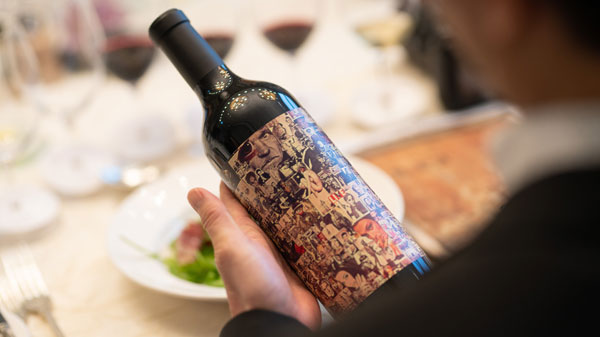
Abstract 2017 – California Red Wine

Orin Swift

Left to age for over a ten-month period, the Abstract combines the rich tastes of grenache, syrah and petite sirah grapes. Delighting with aromas of milk chocolate and black tea, the texture of the wine is truly as impressive as its smell, thanks to the subtle hints of blackberry and mocha, which result in a smooth and fruity blend. With a 15.7 percent alcohol content, we recommend savouring this wine slowly, for a long finish.

Mercury Head 2016 Napa Valley Cabernet Savignon


Orin Swift

The Mercury Head is acclaimed as the best Cabernet Sauvignon from Orin Swift, with the grapes sourced from premier vineyards such as Stagecoach Vineyard atop Atlas Peak. The mouthfeel of this particular bottle is slightly more complex and drier than the other wines, but still remains just as smooth. Its bold notes of dark fruits such as blackberries and boysenberries make it the most seductive of the wines on offer.


For more information and to purchase Orin Swift wines one may visit www.watsonswine.com

Text: Bailey Atkinson

Raise a toast to daddy dearest with Louis XIII cognac

Our fathers are the silent heroes in our lives. This Father’s Day, surprise your dad with a premium cognac from French luxury cognac brand Louis XIII – an ideal gift with a special engraved note of ‘Happy Father’s Day’* as a tribute to this very special man in your life.

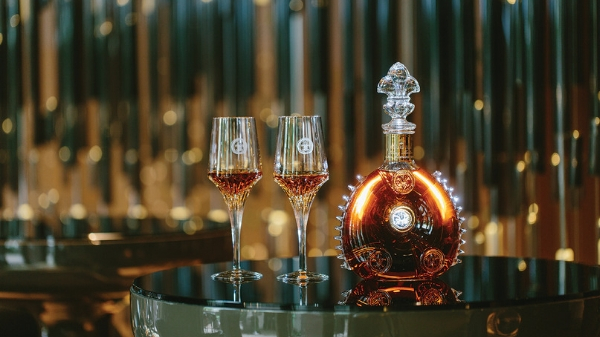
Louis XIII

At Louis XIII, legacy carries a lot of weight. Just like our fathers mentor and guide us, each generation of cellar master at Louis XIII creates and nourishes the special cognac that carries the maison’s legacy into the future. Just as our relation with our father bridges the gap between the past and the future, so also the transmitted knowledge of each of Louis XIII’s cellar masters creates a bond between the past and the future – culminating in the cognac that lives on for generations…

The enchanting beauty of the cognac is visible in its rich amber hues, but it is only in its aroma and taste that a whole range of flavours open up – from light floral notes of dried roses and honeysuckle mingled with the rich candied notes of preserved plums to rich notes of cigar box and leather giving way finally to the vivid freshness of passion fruit, spiked with ginger, thyme or myrrh. With each drop, opulence vies with vivacity making every tasting a special occasion.

Louis XIII

But notwithstanding the rich aromas and flavours of the drink, gifting a Louis XIII cognac to your father is also very much a symbolic gesture. As a family-run luxury brand born in 1874, that still upholds strong family ties, Louis XIII represents a promise to honour family values through time – symbolises the emotional connection between you and your father.

*Engraving service requires one week of time to implement, for more information please contact: Calvin.Chen@LOUISXIII-COGNAC.com

Inside Stewart Cellars: A hidden gem in Napa Valley

There are many reasons to visit Napa Valley. Beautiful landscapes, award-winning wines, famous distilleries, all contribute to making the valley a perfect tourist destination for both day trips from San Francisco and longer excursions for true-blue wine lovers. Well over three million visitors throng to Napa every year, making it one of California’s most popular destinations.

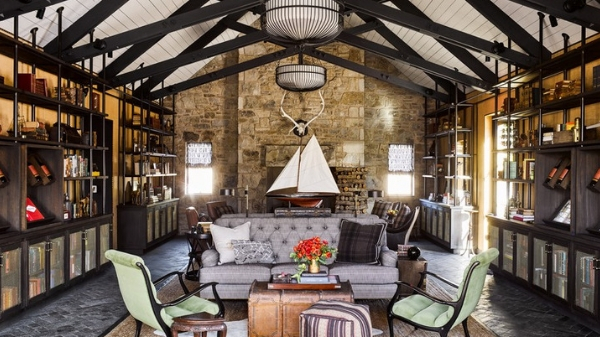
NOMAD Heritage Library at Stewart Cellars

No doubt eager to attract this influx of incoming visitors, hundreds of wineries jostle for attention here, making it a tad bewildering to choose one particular favourite. While such big-name distilleries as V. Sattui Winery, Darioush Winery and Castello di Amorosa draw the lion’s share of footfall every day, we chose to dive a bit deeper and focus on a lesser-known family-owned winery named Stewart Cellars.

A young brand, which came into being only in 2000s, it’s entirely family-run by founder Michael Stewart, his son James Stewart, daughter Caroline Stewart-Guthrie, and son-in-law Blair Guthrie. With the family overseeing all aspects of the business, it’s quality and quality alone that is at the focus of this charming little winery. To ensure only the best-quality cuvees make it to the bottles, Stewart Cellars works solely with all six heritage vineyards by famous grape-grower Andy Beckstoffer, who is known for driving Napa Valley into the world-class grape-growing region it is today.

Stewart Cellar’s premium range – Nomad

Though it’s a relatively younger winery, it is mainly its Cabernets that sets apart this particular maison. While their Slingshot range of Cabernet Sauvignons – younger, easier drink – would attract a wine novice, it’s Stewart Cellars’ Nomad collection that has the potential to catapult them to the big leagues. Particularly impressive is the 2016 Stewart NOMAD Beckstoffer’s Dr. Crane, which scored 97 points in acclaimed wine-critic Robert Parker’s rating. With flavours of vanilla, blackcurrant and coffee giving way to an oaky, long finish that lingers in the mouth with a velvety feel, it’s a truly layered full-bodied wine that is sure to be the highlight of any tasting.

Now, fortunately, you don’t really have to travel thousands of miles to lay your hand on this particular appellation or any others from Stewart Wines. Golden Gate Wine, a leading wine merchant in Hong Kong, brings to us the choicest of Napa Valley wines. For details, please visit their website.

Cognac conversations with Florian Hériard Dubreuil, Brand Ambassador of Rémy Martin

The name ‘Dubreuil’ brings with it respect and responsibility in equal measure. It is after all the very same family that has held the reins of leading cognac maison, the House of Rémy Martin, since 1965. So it was a special occasion for the maison when Florian Hériard Dubreuil, a fourth-generation member of the distinguished family, and the International Brand Ambassador for the House of Rémy Martin flew to Hong Kong to facilitate a unique pairing experience with premium cognac Rémy Martin XO and gourmet chocolate, courtesy of leading chocolatier La Maison du Chocolat. We caught up with Mr. Dubreuil as he took us on a journey to reveal the legacy and opulence of Rémy Martin.

Rémy Martin

What is like to grow up in a family which has such a rich legacy?

It was both a blessing and a privilege to have grown up in such an illustrious family, which gave me the opportunity to be exposed to great experiences, great aromas, legendary cellar-masters, gourmet gastronomy… and living your life as an art. It’s also an honour to have been transmitted this special know-how to inspire other people to continue our legacy.

 What is the universal appeal of Rémy Martin XO?

Rémy Martin XO is an opulent mix of aromas with a lingering long finish. We use the eaux-de-vie from grapes grown only in the best Cognac regions – Grande Champagne and Petite Champagne, together known as Cognac Fine Champagne. And we then age it for a long time to give it a wide range of aromas – of flowers, fruits and spices, reminiscent of late-summer fruit, juicy plums, ripe figs and candied oranges, hints of cinnamon and hazelnut from ageing in oak barrels, along with a velvety texture, flamboyant mahogany colour, supreme density and exceptional mellowness.

Rémy Martin

Why do you think a cognac like Rémy Martin XO pairs so well with chocolate?

 From growing fruits to perfecting their subtle aromas, both cognac and chocolate are created in unexpectedly similar ways, developing complementary flavour profiles. Chocolate pairing especially enhances the roasted dry fruits and cocoa facet of Rémy Martin XO’s aromatic spectrum.

What are the best ways of appreciating cognac in Hong Kong’s tropical climate?

The ideal temperature to savour Rémy Martin XO is around 23˚C. But if you’re outside and it’s hot, don’t hesitate to add some ice to your drink. It actually mellows the intensity, and the fruity notes open up even more.

With climate change being a sad reality, how do you protect your vineyards from the harsh effects of global warming?

 It is our biggest challenge. We have experienced several really warm seasons for quite some time now. Whereas earlier we used to harvest in mid to late October, we harvest in early September now. There has been a lot of research over the last fifteen years to identify long-term solutions such as varietal innovation or resisting grape varieties.

To that effect, Rémy Martin has a large test plot of around one hectare for the planting of new varieties of grapes, which will meet the viticulture conditions of the future.

Thank you.


Great Bruttania: Can British sparkling wine out-champion champagne?

Champagne, that most favoured of fine French sparkling wine-producing regions, has long held a monopoly when it comes to the supply of socially-acceptable bubbly beverages. In fact, until très, très récemment, any non-Gallic grape grinder bold enough to dabble in bespoke bubbly – particularly if they hailed from the wrong side of the Channel, as British sparkling wine certainly does – would have gotten notoriously short shrift.

Tracking the rise of British sparkling wine

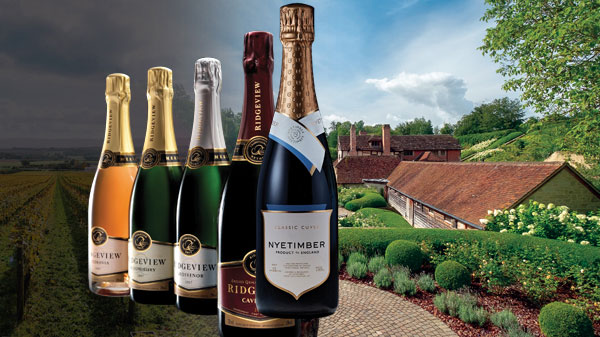
That all changed, however, and at a very particular time – January 2010. It was that month, during the ever-prestigious World Sparkling Wine Championships in Verona, that – much to the shock of a contingent of hitherto-unbeaten champagne producers – the UK-originated Nyetimber Classic Cuvée took home the tasting tournament’s top accolade. Even more gallingly, it saw off such previous festival fizz favourites as Dom Pérignon and Louis Roederer to do so. Since then, English sparkling wines have gone from strength to strength, racking up a total of 15 Best Sparkling Wine titles.

So, what exactly has driven the British sparkling wine to becoming a true bubbly behemoth? According to the experts, it seems we have global warming to thank. As the world’s temperatures have risen, the counties of England’s southern coast – notably Kent, Sussex, Surrey and Hampshire – have become increasingly viable when it comes to the production of sparkling wines.

Global warming has caused England's southern coast to become viable for British sparkling wine making

Addressing the effect of this climatic shift on the terroir of southern England, Eric Heerema, Chief Executive of Champenois-smiting Nyetimber, said: “The Home Counties now boast the perfect conditions for the production of sparkling wine. In particular, the cool climate encourages the slow ripening of grapes, allowing local winemakers to deliver truly delicate flavours, ones ideally-suited to the production of truly fantastic sparkling wines.

Unsurprisingly, it’s a development that has not slipped under the radar of the wider world of wine, with the huge influx of investment capital and professional expertise now pouring into the region being an apt testimony to this. Two of the most high-profile British sparkling wine producers – Woodchester Valley and Rathfinny – for instance, have both lured substantial domestic backing. Perhaps more surprisingly, two well-established French champagne houses, Taittinger and Pommery, have also seen the light. This has seen them, separately, invest in their own estates across the Channel with a view to producing a new line of English sparkling wines using traditional champagne techniques and grape varietals.

No, it's not France, it's a British sparkling wine vineyard

According to WineGB – the country’s national organisation for grape nurturers and winemakers – more than 2,500 hectares of English and Welsh land have now been co-opted by the wine industry. This equates to some 170 vineyards and around 160 wineries. While sparkling wine accounts for 71 percent of their collective output, there is also now a smattering of reds, whites and rosés being produced. In 2018, apparently, the UK wine output rose to a record high of 15.6 million bottles – a staggering 264 percent increase over the previous year’s frost-afflicted 5.9 million bottles.

In fact, the organisation is so sure of the sustainability of this relatively new-found industry that it is predicting that roughly 30,000 new jobs will be created over the next 20 years. On top of that, by 2040, it is forecasting that wine production will contribute as much as £658 million (HK$6.8 billion) a year to the UK GDP through a combination of domestic and international sales, as well as vineyard-led tourism.

Examples of great British sparkling wine

Capturing this new-born confidence in the British sparkling wine sector, Jancis Robinson, a UK-based wine critic, said: “Gone are the days when the English wine industry was dominated by those who decided to try out viticulture in a superfluous pony paddock. The country’s vintners are now producing sparkling wines capable of challenging not just supermarket champagnes, but also the likes of Krug, Cristal and Dom Pérignon.”

While it’s still too early to pronounce on the long-term prospects of Brit bubbly, there are at least clear hopes for continued short-term success. With the results of this year’s World Sparkling Wine Championships currently being decided – and set to be announced in just two months’ time – it could well be that champagne’s previously all-conquering confidence is set for yet another knock. While that may be bad news for the ex-champions of Champenois, it could prove a rare bit of good news for Brexit-blighted Blighty.

Text: Tenzing Thondup
Photos: Nyetimber, Pommery

Restaurant review: Ignis by Linx, a contemporary resto-lounge for sophisticated revellers

It’s a bold move to open yet another resto-lounge in the rather-saturated party hub of Lan Kwai Fung, but Ignis by Linx, that opened doors just a few months ago on the first and second floors of California Tower, seems more equipped than most to meet the challenge. 

Ignis by Linx
Interiors at Ignis by Linx

Sprawling over two floors – a modern club and lounge space on the first floor and a decadent dining room on the second, connected by a spiral atrium staircase – Ignis seems designed to allure the more sophisticated breed of revellers, those who wouldn’t settle for anything less than top-class tipples, while also enjoying a vibrant high-octane entertainment experience. And, thankfully, the bevvies at Ignis far from disappoint.  

Ignis by Linx
Fourth Hokage with Tanqueray, Four Fox sake, lemongrass syrup

Under the careful craftsmanship of bar manager Paulo Quejano, the classic cocktails here get a modern makeover – so we have the timeless Old Fashioned given a contemporary twist with fat-washed bourbon, peanut butter and truffle, while the much-loved Cosmopolitan is reinterpreted with orange Curaçao liqueur, slow-cooked with raspberries, thyme and a hint of turmeric. 

Ignis by Linx
Cosmopolitan

Suitably satiated, guests can turn their attention to matters more gastronomic, and here too, Ignis’s menu can hardly fail to impress discerning gourmands with its contemporary cuisine that deftly blends Western elements with Asian touches. It’s a feat achieved by none other than executive chef Mark Sin, who has previously worked at such acclaimed restaurants as Tom Aikens and Mirabelle in London, and Bo Innovation in Hong Kong.

Ignis by Linx
Mushroom with confit egg yolk & potato puree

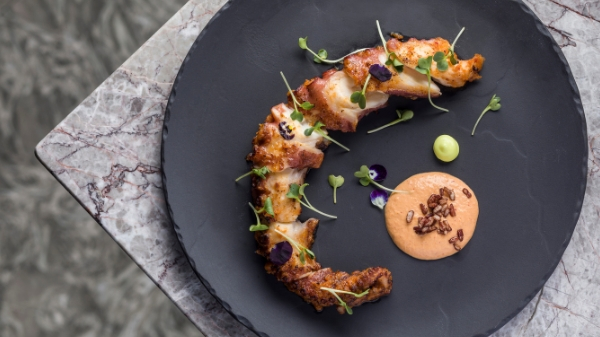
From the carefully-curated menu, the standouts that we would recommend are, of course, the morels and king mushrooms with confit egg yolk, a rich decadent affair with creamy yolk and tomato puree, and the petite-sized lobster bisque, which featured a single lobster wanton in chili oil, a perfectly savoury appetite-enhancing start to any meal. Moving on to the mains, the grilled octopus leg with kimchi mayonnaise and ponzu daikon would vie for your attention, both due to its enormous portion and its soft, yet mildly charred texture. Another crowd-pleaser is easily the succulent mint-crusted lamb loin served with home-made onion jam and house-fermented pickled mustard.

Ignis by Linx
Grilled octopus leg

It is, then, safe to say that it’s its cuisine and ambience that makes Ignis by Linx a worthy addition to Hong Kong’s favourite party destination, but only time will tell if the resto-lounge can capture and hold the fancy of the city’s famously fickle partygoers. We hope it does, because we’d like to give Ignis our metaphorical thumbs-up!

Ignis by Linx
1 & 2/F, California Tower
Lan Kwai Fong
(852) 2623 0298

Text: Suchetana Mukhopadhyay

Liquid Gold: The most expensive Japanese whiskies ever sold

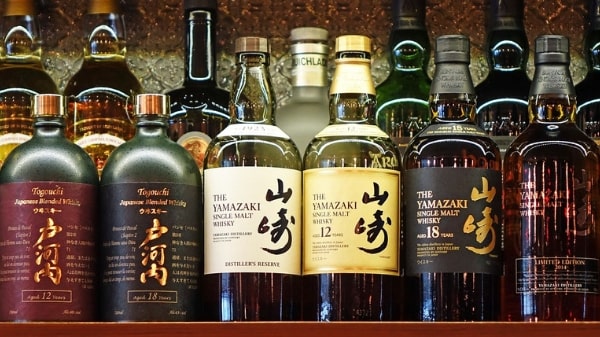
While Scottish single malts have long held sway over discerning alcoholic beverage boffins, it’s no secret that the world has now fallen head over heels in love with Japanese whiskies. In fact, in 2018 alone, three much-coveted vintages of these newcomers smashed all expectations at auction and set consecutive and ever-increasing records for the most expensive bottle of Japanese whisky ever sold. Here are the three amazing bottles behind the stunning upset.

Top three most expensive Japanese Whiskies

Yamazaki 50-year-old Single Malt

Right at the start of 2018, one particular Sotheby’s auction saw a new record set when a Yamazaki 50-year-old single malt sold for an eye-watering HK$2.337 million. To put things into perspective, a more affordable Yamazaki 12-year-old currently sells for roughly HK$1,000, making this vintage lot a true star attraction.

Most expensive Japanese whiskies - Karuizawa 1960 52-year-old The Dragon

Karuizawa 1960 52-year-old The Dragon

Scarcely had the dust settled when, in May 2018, another record was set at a Bonhams Hong Kong auction. The culprit? A rare Karuizawa 1960 52-year-old The Dragon, one of just 41 bottles produced and the unquestionably the oldest Karuizawa whisky in the world. The final hammer price? A staggering HK$2.45 million.

Most expensive Japanese whiskies - Yamazaki 50-year-old single malt

Yamazaki 50-year-old First Edition

The title of ‘Grand Daddy of all Japanese Whiskies’, though, undoubtedly goes to an extremely rare Yamazaki 50-year-old First Edition, which was purchased at a Bonhams Hong Kong auction in August last year for a record-breaking sum of US$343,000 (HK$2.69 million).

While Japanese whiskies still have a ways to go before they can challenge the current record-holder of the most expensive whisky ever sold – an accolade held by a Macallan Valerio Adami 1926 60-year-old, which sold for HK$8.64 million – there is no question that the whisky makers of Japan have quite literally hit upon liquid gold.

The Residence: A singular drinking and dining journey by The Singleton whisky


Single-malt Scotch whisky-maker, The Singleton, created a unique drinking and dining experience at The Residence at this year’s Taste of Hong Kong. Propagating the art of slow craft, The Residence by The Singleton coaxes diners to embark on a leisurely journey through the premium single-malt’s 12-, 15-, 18- and a limited edition 14-year-old expressions discovering the full range of flavours along the way.

The experience is curated to allow patrons to appreciate the various nuances of its slow craft, as pioneered through The Singleton’s long fermentation periods and slow distillation methods.

As a premium single malt with fruity and spicy flavours, The Singleton is known to pair well with Asian cuisine. To celebrate this harmonious combination, the whisky producer invited internationally-known chefs Justin Quek, from Singapore, and Andrew Wong, from London, to showcase their culinary genius and prepare signature dishes that champion the value of slow cooking, and pairs perfectly with each expression of The Singleton.