
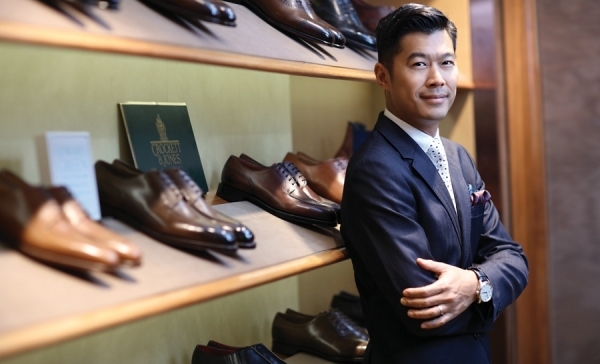
Jonathan Young, co-founder of Tassels, explains how he stays in-step

IMG_7178 re

You grew up in Hong Kong. Can you tell us a little about your childhood?
I was born here and lived in the city until I was 12. We then moved to Beijing, which was quite unusual back in the 1980s. At the time, most people were looking to move to Canada, the US, the UK or Australia. As my father was going to work in Beijing, he thought it would be good for me to experience life there for two or three years. I studied at a local school and began to learn Mandarin. I’m glad I did. It’s so much easier to learn a language when you’re young. In total, I spent two years studying in Beijing, then I went to boarding school in the UK.

As China is such a big country, my father believed that – in time – it would offer a huge number of business opportunities. He always encouraged my brother and I – and indeed the whole family – to travel. He was a fervent believer that the more you see, the more you learn. It’s so important to get to know different cultures and it’s a lot easier to learn by seeing, feeling and talking to people rather than just by reading books. As a result, my family travelled to more than 30 countries. We would travel every summer and every Christmas. To this day, I still love to travel.

Click here to see more on video

IMG_7255 re

“When the police first saw the state of the car, they assumed we were all dead”

After living in HK and Beijing, moving to the UK must have been a bit of a culture shock…
Moving from Hong Kong to Beijing, in the first place, involved a degree of culture shock. Back in the ’80s Beijing was very different to how it is now. Today, it’s quite an easy place to live. Back then, though, they had no idea about customer service for instance. They’re getting there now, though. Back in the ’80s, we had to argue with the sales staff all the time.
The UK was very different again. The way that UK people think is quite different to the way Chinese people think. In Hong Kong, for instance, academic success is very important. At boarding school in the UK, though, there was a broader approach. They believed you should not limit yourself to just one area of activity. There was a belief that you should grasp every opportunity and see what you enjoy. In truth, it’s only by trying different things you find out where your strengths lie. It ended up being a much more rounded education.

In terms of Tassels, why do you think it has become such a success in Hong Kong?
Well, we are very selective in terms of the brands we work with, all of which tend to have a considerable heritage. While most of them date back more than 100 years, they are still family-run businesses, all run by people who genuinely love shoes. Another reason is that we are all very knowledgeable when it comes to footwear. When it comes to dealing with customers, we can all talk to them about shoes and share ideas and knowledge. We have become something of a shoe gathering place. People come and see nice shoes and then discuss related issues.

Have you ever had a near-death experience?
When I was 11 years old, I was involved in a major car accident. To this day, my hand still carries the scar. I lost skin and bone so I had to have surgery. They grafted skin from my foot onto my hand and shaved half of the bone from my toe to replace my finger. It all happened when we were driving along the Tolo Highway, when my mom passed out. It was just as she was turning, so we struck a slope and rolled down a flyover. I was thrown out of the car as I wasn’t wearing a seatbelt – that was never a requirement in the ’80s. My brother was also thrown out as the car flipped upside down.
When I opened my eyes, my finger was dangling off my hand. There was blood everywhere. Luckily that was the worst injury. My brother had to have seven stitches on his head and my mother had to have stitches on her finger. All in all, though, it was a very lucky escape. The roof of the car was totally flattened. When the police first saw the state of the car, they assumed everyone had died. Luckily, though, my mother and brother were able to walk to the hospital, while I was taken in a wheelchair.
The police contacted my father to tell him we had been in an accident and advised him to come to the hospital immediately. He was expecting to find us all on stretchers. When he saw us walking out of the ambulance, he was hugely relieved.

Which profession do you consider the most overpaid?
I don’t feel any profession is overpaid. It is a free market so pay reflects the value you add. If you are indeed overpaid, the market should automatically adjust to match the value you add and the demand for your services.

What is in your wallet right now?
Some cash – although I don’t usually carry a lot – some credit cards, ID, of course, and some shareholder cards. I have a stake in several bars and restaurants – including Lilly and Bloom, Play and Studio – so I carry my shareholder cards around. Name cards of course, my joint bank account card with my wife, my Jockey Club card, some receipts and a bunch of different SIM cards for when I am travelling.

Where do you tend to travel to most often?
For business, I travel to the US, the UK and Italy. When it comes to leisure, I travel to Europe once a year for skiing, I love skiing. We try to arrange a ski trip every year to France or Austria. I also love scuba diving, preferably in Malaysia, Indonesia or the Philippines.

Where are your favourite diving haunts?
Sipidan is beautiful and I went to Tubbataha on a live-a-board which was amazing. It is about 16 hours from Palawan Island so you travel out on the boat overnight. The next morning, you are at the dive site and then you just dive, dive, dive for five whole days. You don’t see any land at all, just reefs and two atolls beneath the water. A scary moment came when I saw a six metre whale shark and a tiger shark swim right towards me. While not quite a near-death experience, it was one of the scariest moments I have ever had.
We were diving off a cliff and I was the one furthest out. I was looking out into the distance and suddenly I saw this Great White headed right towards me and I thought: “Hang on a minute, why am I seeing a Great White in the tropics?” I just froze, it was so big. It was not long, but hugely bulky. All I could see was teeth. All the time, I was thinking: “If it keeps on swimming towards me, what am I going to do?”
When it turned, I could see its stripes and I realised it was a tiger shark. We had been told there were sometimes tiger sharks there, but we were lucky to see one. It was clearly a curious shark and it was definitely checking us out.

IMG_7239 re

“There was a Great White swimming towards me. All I could see was rows and rows of teeth…”

Do you believe in the death penalty?
I don’t. Not because no crime should be punishable by death, but because any judgement could be wrong. Someone could be innocent, wrongly convicted and executed. There is no going back after that. Okay, otherwise, they could have spent time in jail that they didn’t deserve. You can try and compensate for that. You can’t reverse the death sentence though.

How did you propose to your wife?
I proposed in Australia. We had planned a trip there over Christmas. My wife had not travelled as much as I had, so she was keen to see more of the world. As we both like the great outdoors, we decided on a caravan trip. We flew to Perth and rented a 4×4 caravan so we could drive along the trails and go off-road.
I had told myself I would propose during the trip. At first I thought I would do it in the desert, but that didn’t have the right feel and there were too many tourists around. One night, I suggested we drive out to the beach. It was a beautiful beach. We sat and watched the sunset with a bottle of wine. At the time, I thought this is just perfect.
Then, all of a sudden, the wind picked up and there was sand everywhere. It blew into our faces and into our wine glasses. I was left thinking: “This is so bad. It’s not the right time”. Despite this, my fiancée – as she then was – remarked how romantic it was. That persuaded me that it was the right moment after all. As the sun set, I popped the question. And she said yes.

Marie-Christine Lee discusses giving children a sporting chance

A-4

Marie-Christine Lee is the founder of both the Sports for Hope Foundation and Sport Max.

You are the founder of the Sports for Hope Foundation. What led you to set up this particular charity?

I have always loved sports, ever since I was a child. I fundamentally believe that sport can be hugely beneficial – both mentally and physically. Sport gives people a goal and it teaches them to be persistent in many other areas of their lives. It instills in people a never-give-up attitude, something that is essential to have no matter what your aim in life.

Click here to see more on video

“I tend to trust people too much and sometimes that leads to mistakes”

B-139

“There is one person in my life who is my greatest indulgence and my biggest secret”

I decided to set up my own charitable sports organisation five years ago. I really want to give back to society by helping financially-in-need children here in Hong Kong, particularly through the medium of sport. Overall, we try to use sport as a way of reaching out to help children in need, those who may come from poorer backgrounds. We aim to improve their self-respect and boost their confidence. Overall, we give them something to look forward to and help them with their self-esteem.

Is there anything that keeps you awake at night?
There is nothing that keeps me awake at night. If there is a problem it can be solved eventually. I like to be proactive. You can’t just reflect on a problem. You have to find ways to tackle it and that takes time and effort.

Do you enjoy fancy dress parties?
I kind of like to give people surprises. It’s a fun thing to surprise people in that way. My favourite fancy dress experience was when I dressed up as a character from Avatar because it was challenging to paint my whole face and body, standing up for two hours.

What is your favourite aroma?
Rose. It’s pure and elegant. Very romantic.

Are you a good listener or a good talker?
I think I’m a better talker than a listener. My friends always say to me: “Will you please listen to me before you talk.” That may be because I’m a very confident person, but it’s also a weakness. I may be the most confident, but I’m not necessarily the best or the most intelligent. I do have a lot of compassion, though, and a lot of empathy. Usually, I find the right thing for me to do is to talk first because I always talk from my heart.

Do you know your blood type?
Yes, I do. It’s B-positive.

What’s your favourite colour?
Blue, especially denim blue. I also love the sea. I love the bright, blue sky. They give out energy, hope and happiness.

English or Cantonese?
My mother tongue is Cantonese. But when it comes to expressing my feelings and emotions I feel more comfortable with English.

B-467

Famously, you rode a bike across the Uygur region of northern China. That must have been challenging…

It was part of a fund-raiser and a way of kick-starting my foundation. Whenever I can, I like to take myself out of my comfort zone, as I’ve been very fortunate with my own upbringing. I have always had a lot of love from my family and a lot of support from my friends. As a result, I’ve always lived in a very comfortable environment. So I realised, when I started the Foundation, that I had to show people that you shouldn’t always stay in your comfort zone. Everyone can take on new challenges.

The Uygur region was new to me and I’d never even thought about trying mountain cycling in my life. To make matters more challenging still, even though I had professional riders with me, they had never been there before either. So the whole thing was planned so that we could complete our mission through sheer determination and our ability to adapt to the unknown – the environment, the climate, the culture, the whole thing.

Do you have a secret you could share with us?
I only share my secrets with my family and best friends.

What was the last thing you got for free?
I never get anything for free.

What do you want to be remembered for?
Compassion. Empathy for people. Love for people.

What’s your astrological sign?
Aquarius. While I’m not too knowledgeable about astrology, I’ve been told I am a typical Aquarius. They are very passionate people and they’re very sensitive. It’s also a water sign – and that suits me too. I love the water.

What has been the best birthday present you have ever received?
My best birthday present is love and respect from my children.

If you could bring about world peace or end global famine, which one would you go for?
Can I say both? I don’t think the world’s problems can be separated out. You can’t establish a priority because the two can only be solved jointly.

Are you a radio listener?
Yes, if it’s about sports and health issues.

What are your favourite sports?
My favourite sports are the two I was introduced to when I was very young – tennis and swimming. I’m very competitive and that’s part of the fun of taking part in any sport. Of course, you also have to like the sport – and I love those two in particular.

B-357

“When it comes to expressing my feelings and emotions I’m more comfortable with English” 

When you’re swimming, you’re basically competing against yourself and basically always striving to beat your personal best. With tennis, of course, you’re competing against others, so there’s also interaction in the mix. I basically love anything outdoors. I much prefer to swim in the sea or outside rather than in an indoor pool. And tennis always has to be outdoors for me.

What do you consider to be your biggest mistake?
I tend to trust people too much and sometimes that leads to mistakes.

Do you have a favourite food?
Rice. Steamed. I can even eat rice for breakfast. It’s very much my staple. I cannot eat anything if it’s not accompanied by rice.

Chopsticks or cutlery?
Chopsticks, of course, because my favourite cuisine is Chinese and Japanese.

What has been your greatest indulgence?
Does it have to be materialistic? Can my indulgence be a person? There is one very special person in my life that is my indulgence. This, though, I will keep a secret…
What’s next for you?
I am still very much committed to giving back. So, since the Foundation launched five years ago, I have had to keep coming up with events to raise funds and awareness. I need to spread this concept to the rest of Hong Kong to help make it a more sports-nurturing place. This is affected by the demographic of the city. We have very limited space and the school system is more geared to academic achievements than sporting excellence. On top of that, parents don’t see being an athlete as a long-term thing. They believe it’s better for the children to become doctors, engineers, accountants, lawyers…
I truly don’t believe that is the case. While not everyone can be an Olympian, as long as you have a passion for a particular sport, that will benefit your whole mindset – as well as every other aspect of your life.

Thank You

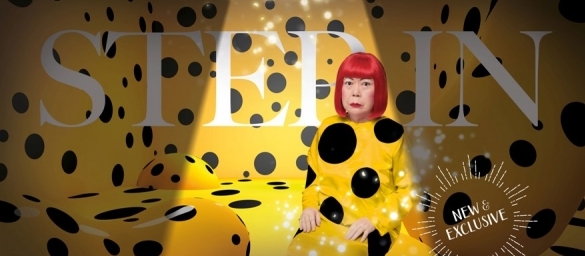
Japanese artist Yayoi Kusama immortalised in wax

Waxwork museums are the perfect place for us mere mortals to grab a photo and get up close and personal with celebrities. Well, the waxwork version of them at least, which is enough for most people.

Visitors to Madame Tussauds in Hong Kong get to rub shoulders with wax versions of David Beckham, Taylor Swift, Her Majesty Queen Elizabeth II and Xi Jinping, among others. Thinking about it, Beckham, Swift, Queen Elizabeth II and Jinping would be interesting guests to invite to your dinner party.

And to add its collection, Madame Tussauds has just announced the launch of a new waxwork, “the queen of polka dots”, renowned Japanese artist Yayoi Kusama, who will get her own themed zone.

The zone’s design draws from the artist’s iconic polka dots and gourd motifs, and invites visitors to experience the concept of “self-obliteration”. The Yayoi Kusama themed zone adopts yellow as the main colour with repeating black dots.

The zone will open on 3 November.

Long Reigning

The Rio Olympics saw many sporting superstars enhance their already brilliant reputations. There was Usain Bolt – the sprinter supreme – in the athletics stadium, for example, while Katie Ledecky – the teenage swimming sensation – made an equally big splash in the pool. For one of China’s golden greats, though, winning in Brazil not only confirmed his position at the very top of his sport, it also marked the moment when he moved from being a phenomenon to becoming a genuine sporting legend.

Ma Long’s four-set demolition of Zhang Jike, his compatriot, in the men’s table tennis Olympic final saw him become just the fifth man in the history of the sport to complete the fabled grand slam – the triple crown of world championship, world cup and Olympic titles. He also became only the second to hold all three at the same time.

Not only that, he’s also the first man ever to hold all of these titles simultaneously, while also being the reigning champion in the International Table Tennis Federation’s (ITTF) World Tour. This is not to mention the fact that he’s the first to have won every major singles title he’s eligible to win, from national championships to regional tournaments to the majors. In short, it’s fair to say that he has come to utterly dominate the sport.

This month, fresh from his Rio triumph, he will attempt to retain his ITTF World Cup title, taking on 15 of the top players from around the globe in the German city of Saarbrucken. It’s a competition he’s won twice before, most recently in 2015 when his astounding attacking play defeated Fan Zhendong, his national team-mate, in the final.

That victory in Sweden marked the climax of a truly glorious year for Ma, a 12-month period that saw him claim six major titles and lose just once in an international competition. Coupled with his Olympic success this July, it’s clear he is at the summit of a glittering table tennis career.

The career, however, might never have even materialised had it not been for the determination of his parents. Ma is the first to admit that, as a child, he had no particular fondness for table tennis. He says: “I started playing at 4 or 5 years old. It wasn’t really because I loved the sport, though, but more because it was something new to me. I think, at the very beginning when I started playing, it was more because of the influence of my parents. They took me to practice every day.

“My parents wanted me to play to improve my health and fitness. As an indoor sport, table tennis has a high level of technical requirements, making it extremely suitable for Asians to play. In the beginning, it was more about playing to see if the sport was for me. It was only after playing for a few years – when I was about 8 or 9 years old – that I started to get a real liking for it. It was then that I found I truly had a love for the sport.”

That love was further nurtured by watching some of the great names of Chinese table tennis achieving glory on the international stage. Ma says: “What really inspired me to become a professional player was seeing how the national team players – such as Liu Guoliang and Kong Linghui (Olympic gold medal winners in 1996 and 2000 respectively) – were fighting for the honour of our country. It made me look up to them and to want to earn honour for China. I always admired their style. As a child, I idolised them.”

At the age of 13, Ma’s potential became clear and he was brought to Beijing for advanced training. Two years later, he had progressed to such an extent that he graduated to the Chinese national squad. It was here that he came under the wing of one of his heroes – Liu Guoliang, then the national team’s head coach.

000_EQ9QH

Ma maintains that support given to him at this stage was crucial, saying: “A lot of people have helped me at different stages of my table tennis life and career. One of the most important phases, though, was when I first joined the national team.

“I owe so much to my coaches – Qin Zhijian, who started coaching me in 2006, and Xiao Zhan, who coached me when I first joined the second team. Then, of course, there is Liu Guoliang, who encouraged and nurtured me throughout my time with the national team.”

Within a year of joining the squad, he’d won his first major titles – the Asian and World Junior championships. By the age of 18, he’d won his first world senior title while competing in the ITTF Team World Championships. After that, he progressed so quickly that by 2009 he was ranked number two in the world, having won eight ITTF world tour tournaments, two Asia Cups, and reached the semi-finals of that year’s world championships.

It was at this semi-final in Yokohama, however, that doubts about Ma’s ability to reach the very top of the sport began to surface. Beaten by the then number one, Wang Hao, this defeat was to mark the start of a run of three successive losses to the same man at the same stage of this prestigious tournament.

Ma admits that his inability to overcome his rival at this level became somewhat frustrating, saying: “I was in different situations for the three world championships. In 2009, there was certainly a gap in terms of technique and skills between me and Wang Hao, so it felt normal losing to him.

“In 2011 in Rotterdam, I felt there was a real chance to beat him, but I failed to deal with one or two crucial points and eventually lost. That was a real disappointment. In 2013 in Paris, I definitely had the advantage, but didn’t play my best against him in the semi-final match.”

Matters weren’t helped when Liu Guoliang publicly commented that, although Ma had all the tools to reach the top of the sport, he lacked the mental toughness needed to play to his full ability in major tournaments. Seemingly bearing out Liu’s analysis, Ma missed out on a spot in the men’s singles for the London Olympics, after a couple of shock defeats had seen him fall down the ITTF rankings in the run-up to the Games.

The disappointment of London, however, only inspired Ma to greater heights. He won the World Cup, his first Grand Slam tournament, later that year. A year later, he took the Asian Championships and was named the best player at the world team championships in 2014. In March the following year, he reached number one in the rankings, a position from which he is yet to be dislodged.

epa05475814 Long Ma of China celebrates a point against his compatriot Jike Zhang during the men's singles gold medal match of the Rio 2016 Olympic Games table tennis tournament at the Riocentro in Rio de Janeiro, Brazil, 11 August 2016. EPA/LARRY W. SMITH

In 2015, he finally ended his world championship hoodoo, possibly helped by the absence of his nemesis, Wang Hao. He hardly dropped a set throughout the tournament, before overwhelming the up-and-coming Fang Bo in six sets in the final.

Freely admitting he was relieved to have finally clinched the title, he says: “I was very happy to win my first world championship title after losing to Wang Hao three consecutive times in the semi-finals. That put me under a lot of pressure this time to win the title – especially during the semi-final stage.”

Since then, Ma has reigned supreme at the table and achieved true Olympic glory. It’s clear that winning in Rio was especially important to him after the disappointment of 2012. He says: “I am very glad to have completed the grand slam and to have become Olympic champion. I didn’t stress too much during the final. I did my best and I’m extremely happy that I took the gold medal. It was a very special moment in my career.”

The two golds he picked up in Rio – he also helped China to victory in the team event – added yet more lustre to his long list of honours and achievements. What is it, though, that has made him quite so dominant? Tom Lodziak, one of the world’s leading table tennis coaches, believes it is because he doesn’t appear to have any weakness in his game.

He says: “Ma Long’s always had an exceptional forehand. His topspins are fast and powerful and he can place the ball anywhere on the table with phenomenal consistency. It’s not all about his forehand, though. He has made big improvements to his backhand over the years. In the past, opponents would go after his backhand, but this is far less effective now, as he seems to be equally as strong on both sides.

Ma Long, of China, center, holds his gold medal as he stands with silver medalist Zhang Jike, of China, left, and bronze medal winner Jun Mizutani, of Japan, right, after the men's table tennis gold medal match at the 2016 Summer Olympics in Rio de Janeiro, Brazil, Thursday, Aug. 11, 2016. (AP Photo/Petros Giannakouris)

“There is also more variety to his play. It’s not all about the power, although this is clearly his major strength. He is very clever in how he uses pushes and blocks to keep his opponents off balance. When he’s in the mood – usually when he has a comfortable lead – he’ll throw in the occasional chop-block to really mess up his opponent.

“His physical conditioning is exceptional. It has to be to be able to play such a fast, powerful topspin game. Ma Long, and the other top Chinese players, have taken table tennis athleticism to a new level. I really enjoy watching him play. Even though his matches are often one-sided, I get pleasure from watching a master at work. He can make other professional players look like mere amateurs.

“I think now he has a strong claim to be the best of all time. Of course there are other contenders and it’s very difficult to compare players from different eras. Techniques have evolved. Tactics have evolved. Equipment has evolved. The rules have evolved.

“Sweden’s Jan-Ove Waldner is considered by many to be the greatest. He played with style and intelligence and could do things with the ball which seemed impossible. He won an Olympic gold and silver medal and two World Championship singles titles, so Ma Long has a little catching up to do.

“I’m not sure Waldner at his best would have been able to live with Ma Long at his best, though. Ma Long’s extra speed, spin and power would have overwhelmed Waldner’s slightly slower, more graceful game.”

It’s a reasonable conclusion to reach. Ma Long certainly overwhelms most modern-day players, something that was clearly evident in his crushing defeat of Zhang Jike in the Olympic final in July.

Zhang is a year older than Ma and was the last player before Ma to achieve the grand slam, with many once considering him the superior player of the two. During the final, he managed to keep the first set close before scoring a paltry 13 points in the next three. The worry for Ma’s opponents at this month’s World Cup is that they’ll be on the receiving end of a similar trouncing.

Light Entertainment

Chopard chose Sheung Wan’s LightStage as the ideal venue to celebrate the 40th anniversary of its Happy Diamonds Collection. A cavalcade of playful-themed activities kept revellers entertained throughout the night.

Click here to see more on video


The Big Pang Theories

_MG_8767

Joyce Pang is the executive director of the Shenzhen (Nanshan) Concord College of Sino-Canada and co-founder of the China South Chapter of the Entrepreneurs’ Organization.

Click here to see Joyce Pang on video

You are famously active across a range of educational and entrepreneurial organisations. How did you first get involved with them?

My involvement with the Entrepreneurs’ South China Chapter started when I was doing my executive MBA. A friend’s husband had started the Hong Kong chapter, so we got talking about entrepreneurs in general. We’re something of a lonely breed. There are a lot of issues that come up that you can’t discuss with friends who are not entrepreneurs.

The important thing about the entrepreneurs’ organisation is that it offers a very private and safe environment. One of the key aspects of it is that it offers a forum discussion format where everything discussed is confidential – you are not even meant to talk to your spouse about it. Within the forum, you are free to talk about anything. You can talk about family, you can talk about life in general and, especially, work issues of course. It helps that you can talk to people who have experience of similar issues and that they can give you advice on what they did – sharing the experience of what they have done in similar situations. It also enables you to address certain issues that can arise when you’re running a family business.

_MG_8978

I am also the executive director of the Concord College of Sino-Canada and the international schools. I basically run the behind-the-scenes function of what a school normally does. I handle the teacher-principal hiring and also the business side.

From when I was in school to now, the things that are now taught are very different. Today there is a focus on what we call 21st century learning. It’s all very interactive and not at all textbook based. It’s never a case of just sitting there listening to a teacher lecturing you. You have teachers that are asking more questions of their students and giving them much more freedom to go out and find the answers for themselves. Now it is a case of the kids actually saying to the teachers: “What we want to learn is this. How do we go about discovering more about it?”

Such an approach to learning is very much geared toward each individual student, giving them the flexibility to explore what they are genuinely interested in. There are different types of learners. Not everybody can just gain knowledge from a textbook. Some people need to feel it, some people need to touch it and some need to hear certain things. So it’s very much more catered toward embracing the learning profiles of different kinds of learners.

Sometimes it’s not about studying. Sometimes it’s more about discovering the best way for you, personally, to acquire information.

_MG_8843

“I love wearing ball gowns, but people think you are a bit weird if you do it all the time”

For your part, what was your first actual job?

It was an internship. I had this uncle who somehow seemed to believe I wanted to be a doctor. So he arranged a job for me at this very well-established hospital in Toronto. Little did he know that wasn’t my ambition at all. As he had arranged it, I went along there and found myself working with a neurologist. It was an amazing job and I got to see a lot things, but it didn’t pique my interest.

Is there a brand that you would never wear or own?

Hmm… that’s an interesting question. I’m very open to trying new stuff, but maybe Ralph Lauren.
There are certain things he says and also it is a very expensive brand. For my own part, I prefer something much more casual. For the price the brand tends to sell at, I would prefer to wear something else.

What has been your most extravagant purchase to date?

Probably jewellery I would say. And shoes. Lots of shoes.

What was the last movie you saw?

The Secret Lives of Pets.

Have you ever had a near-death experience?

Actually I did. When I was 10 or 11, I almost drowned in a swimming pool of all places. Actually, I may have been much younger, maybe five or six. I used to live in Canada. In summer we would go to a horseback riding camp for half a day and then, for the rest of the day, we might go swimming. Once one older girl said to me: “Let’s go swimming in the deep bay” and I said “I don’t know how to swim.” So she said “It’s okay I’ll hold onto you.” So then we both almost ended up drowning but, thankfully, a lifeguard pulled us both out. We went under for what seemed like a long time but it was probably just a minute or so. Now, of course, I can swim relatively well.

Which clubs are you currently a member of?

The Golden Bauhinia Women’s Association – it’s an entrepreneurs’ sort of club. I have also joined several industry-related clubs. On top of that, I volunteer for Hong Kong Dog Rescue – I love dogs – and Animals Asia. They’re both great organisations.

What’s your favourite accent to listen to?

Australian. And British of course. Actually I like Italian too – they have a very interesting accent. It’s
explosive rather than expressive.

What is your favourite item in your wardrobe?

Ball gowns. They are amazing dresses, but you don’t get to wear them as much as you might like to. You would look fairly weird if you did.

What were your parents’ jobs?

My mother didn’t go out to work. She was very much a stay-at-home mom. Of course, that’s a major undertaking in its own right, especially when you have to handle me and my brother, something that was never going to be easy. My dad, meanwhile, founded the schools that we still have. He’s still working and he still loves it. He travels a lot and now my mom actually accompanies him a lot of the time.

When was the last time you got lost?

Maybe last year on vacation… probably somewhere in Thailand when I was just out walking randomly. I get lost in Hong Kong too. I get lost in Mong Kok, I just can’t get my bearings there. Nowadays, though, you can always find where you are because you have your phone with you and you can just click on Google Maps.

_MG_9184

“My advice would be, when choosing your first puppy, always go for one that’s not too hyperactive”

How did your husband propose to you?

Well, with my current husband, we were together for a long time before we decided to get married. So he just proposed at a restaurant that we both loved going to. It was the Oyster Bar in the Sheraton Hotel. It has a lovely view. The funniest thing is he got me a cake. He had the waiter bring it out and he had the question written on the cake. It was a half-pound cake, and then it was like: “How are we going to finish all this cake now?” It was very nice though. I love cakes.

Are you a good listener or a good talker?

I think I’m a very good listener. I like to listen to people, especially friends when they come to me with difficult issues. I always try to analyse what they’ve said and then do my best to help them.

Sunrises or sunsets?

Sunsets. Sunrises are way too early.

Do you have a particularly cherished memory?

That would have to be when I got my first puppy. It was an American Eskimo dog and very hyperactive. I was seven. I had been bothering my parents for the longest time about getting a dog. I made them so many promises… I’ll walk it… I’ll feed it… And, eventually, I got one. It was a super active dog. Looking back, I think when choosing a first puppy, it’s probably better to choose something less hyperactive.

What was the scariest situation you’ve ever been in?

This summer, we went back to Canada. There’s a theme park there with this huge rollercoaster. It was basically like a tower. I mean you could even see it out by the highway. The funniest thing is that this rollercoaster drops straight down and the only thing holding you in is just this bar. I had my eyes open, because it’s even scarier when you close them. The seating is four people per cart, with two in front, so you can see very clearly that you’re going down. That’s my scariest experience, at least over the past year.

Are kid s getting smarter or just more tech-savvy?

Down the line, technology is going to be an increasingly big part of our society. It’s important, then, that kids have the proper tools and the proper knowledge, allowing them to develop along with the technology. We’ve got kids in primary school who are already creating apps.

When was the last time you told a white lie?

Maybe last week when somebody asked me if something they were wearing was okay. It wasn’t bad… it was okay, but I said: “It looks nice.”

What was your biggest mistake?

Nothing pops into my mind as I don’t tend to see things as very big mistakes. For me it’s just a case of it didn’t work out, so you learn from it and you move on.

Given that we are doing this interview in the Mira Hotel where Edward Snowden hid when he first came to Hong Kong, what do you think of him? Hero or villain?

I don’t think we can categorise him as either. He was a hero in the sense that he blew the whistle on the NSA and let everybody know that they were being bugged, a clear violation of our privacy. I don’t think he can be thought of as a villain because, morally, he clearly thought he was doing the right thing. It wasn’t necessarily the right thing in the eyes of the government though.

Thank you.

Pawn Baron

Alan LO thePAWN 1139_eff2

Describing Alan Lo as one of Hong Kong’s few Renaissance men does not quite do him justice. Perhaps best known as co-founder of the Press Room Group, the company behind a number of the city’s favourite eateries – Classified, The Principal and The Pawn – he is also the driving force behind Duddell’s, the Central-based Cantonese restaurant-cum-art gallery he co-founded with his wife, Yenn Wong. Arguably one of Hong Kong’s preeminent restaurateurs, he has a Midas-like reputation for delivering gastronomic gold at all of his outlets.

Click here to see Alan Lo on video

Where most men would have enough on their hands simply overseeing many of the city’s most popular restaurants, Lo is also the co-founder of Blake’s, a Hong Kong based development and investment business specialising in boutique residential and retail spaces. On top of this, he is the chairman of the Hong Kong Ambassadors of Design, as well as an active member on the Hong Kong Arts Development Council.

“Growing up in the 80s and 90s was a very interesting time. I was born some 17 years before the handover, growing up in colonial HK and then experiencing the transition to the Chinese regime. It was absolutely fascinating. My generation lived through historic times. We saw the city change a lot, becoming the far more developed place it is today.

“I grew up in a family of four – mum, dad and a sister who was eight years older than me, a typical Hong Kong family I guess. My dad works in the world of manufacturing. He’s an industrial designer by training, while collecting a little bit of art on the side. I guess, in a way, I sort of grew up in an environment where I was around a lot of things culture and art related. My parents travelled extensively, so I would get to go to a lot of different cities. I was exposed to a lot of different influences at a very young age.

“Nowadays, Hong Kong is becoming ever more international. It is becoming less British, but it is becoming more globally diverse. Over the last few decades, expats in Hong Kong have mainly tended to be bankers, lawyers and other kinds of professionals. Now, though, we are starting to see increasing numbers of museum curators, fashion stylists, bloggers and photographers. The range of people coming to Hong Kong looking for opportunities and wanting to interact with local people is a lot more varied than before.


Alan LO thePAWN 0254 copy_eff

“Today, there is no consideration as to how Hong Kong can establish a dialogue with the wider world”

“As part of that we have lost our Britishness, which is only natural. This is a different era with a new generation to the fore. Are we, though, also becoming less international? In terms of the way the government runs the city, maybe yes. Organically, though, things are happening. Certain events are attracting international attention. Hong Kong is still a very exciting place, especially in the terms of its art and culture.

“The current administration, though, chooses to focus a lot more on being part of China, as opposed to seeing Hong Kong as a truly international city. There is no consideration as to how Hong Kong can establish a dialogue with the rest of the world.

“I hope that the government has a vision that could take us to the next level and that it has a long-term view of the city’s development over the next 20 or 30 years. It seems, though, the current political landscape only permits a view on short-term objectives.

“At the same time, though, there is also a feeling that the government should actually do less. HK has always been known for its laissez-faire regime and as a place where things just happen. As a platform, it’s naturally attractive and people inevitably gravitate towards it.

“In light of increased competition from Shanghai and Singapore, though, I think it now needs a greater push to ensure things happen. For me, the last 10 to 15 years have been a bit discouraging in that regard. Many of us, though, are doing what we can at the individual level. Things can be accomplished at this smaller level and much has been achieved. Ultimately, quality is a lot more important than quantity in this particular area.

“In terms of gastronomy, I first discovered my love for it when I lived on the East Coast during my university days. At the time, I was based in Princeton, New Jersey, just an hour and a half away from New
York by train. I used to go there every other weekend just to visit friends.

“That was my real introduction to gastronomy and it turned out to be a real eye opener. Today, New York is still regarded as one of the finest cities in the world when it comes to high quality food and showcasing all the latest food trends. It has always been five years ahead of everywhere else, so it was hugely interesting for me.

“I got to know a number of other people who were also really into food and we would go to different restaurants every weekend. When I returned to Hong Kong in 2005, while I was still employed by another company, I had already begun to talk to people about what would be an interesting project to introduce to the city.

“The restaurant scene in Hong Kong has come a long way since then. Back then, you still had hotel restaurants and places in Soho – little hole-in-the-wall places – that had little idea when it came to quality or consistency. That was 10 or more years ago now though.

“Today, it is a completely different scene and a lot of international concepts have come to town. Many celebrity chefs have outlets here, while a lot of young chefs from all over the world are involved in opening new projects. It is a very different scene, with a lot more competition.

“To me, that has made everything a lot more interesting. The community is growing and the dialogue between us and our peers has been taken to a whole new level by the arrival of the Michelin Guide and the Asia’s 50 Best Restaurants initiative. This has certainly drawn attention to the city, as well as to other cities in Asia. Now we are not just out on our own. We are part of a regional and global system, with access to chefs and restaurants from all over the world. It is very exciting.

“Of course, the world of food and beverages is still very cutthroat. I cannot begin to explain how tough this sector is. Becoming part of it seems like both the best and the worst decision I have ever made. It is, however, something I genuinely enjoy and it doesn’t really feel like a job.

“Obviously there are tough moments and challenging times, but overall it has been an amazing experience. I have been doing this for 10 years now and I still feel as though I learn something every day. The whole scene is evolving. It is changing so rapidly that you are forced to run to catch up. It isn’t something where you just shut your doors and carry on on your own. You have to have a dialogue with your peers, both in Hong Kong and across the world.

“In a way, though, we are a bit anti-trend. Our point of differentiation with other players in the market is that we have a genuine interest in creating something truly timeless. For us, it’s not about being part of something that is fashionable for six months or a year. We want to create something that is great the first time you encounter it. At the same time, though, we want it to grow on you, becoming even better over time.

Alan LO thePAWN 0581 copy

“Cities where art is important have a completely different aura to places where it is seen as less significant”

“After we started to expand, it became apparent that we were pioneers in certain neighbourhoods, although that had never been our intention. At the time, we were looking at peripheral areas of busy districts simply because the rents were cheaper and there was a more relaxed ambience, together with a greater sense of a community.

“Often we opted for places where it wasn’t super busy, places where you could enjoy walking around. We felt that that was what a city should be all about – picking up a loaf of bread, browsing a local bookstore and saying ‘hi’ to a neighbour. As with many cities that have evolved incredibly rapidly, we have lost some of that human touch. When we look at expanding, that’s always a concern at the back of our minds.

“When it came to fusing art and gastronomy, I felt – at the time – that there was a lack of appropriate platforms for local artists. This was despite the fact that the city had developed considerably in terms of its number of international galleries and the arrival of several of the major art fairs.

“In the case of The Pawn, back in 2014, we closed for a complete makeover as we had decided to create a new platform solely for native Hong Kong artists. We brought in a local artist, the man who had designed its original look back in 2008, and he helped us curate the space.

“We then loaned from the artist and from a Opposite number of private collections around Hong Kong to create a semi-permanent display. Here you can now view works from some of the most well-known artists on the Hong Kong scene, as well as some big name creative talents from across the world.

“In a way, it is all in line with my personal interests, but we also felt that – as restaurants generally have a lot of people passing through their doors – with the right curatorship we could make use of the space to give back to the art community, if only in a relatively modest fashion.

“Art is increasingly important for a city as it becomes ever more financially prosperous and everyone starts to live a reasonably comfortable life. There is some aspect of every city that differentiates it from every other city, whether that be through culture, art or music. It’s what gives its real identity and it’s an expression of the inner dialogue of its residents.

“The cities where art is important have a completely different aura to those places where it is viewed as less significant. I know this may sound like a rather abstract concept, but I hope that – over time – people will come to have a greater understanding of just why this is important. Only when they appreciate this will they gain a real insight as to why such initiatives as the West Kowloon Cultural District are so important for the wellbeing of any city.

The Fabrikator

A-8379

Mark Saunderson is the Director of the Asia Contemporary Art Show and a Co-founder of Hong Kong’s Fabrik Art Gallery.

Click here to see Mark Saunderson on video

What initially brought you to Hong Kong?

I came to Hong Kong in 1982 from the UK. I was quite a young man at the time. I started in the media business and spent the better part of 30 years in Asia. I did break out of Hong Kong for about 10 years in the mid-’90s when I went to live in the Philippines. I always considered Hong Kong very much my home, though, even when I was living abroad.

You must have seen a lot of changes over the years…

I have been here for 30 years, but I probably spent half that time travelling. I have seen a lot of changes, though, not least in China. Hong Kong, however, has always had an intrinsic energy and pace, which it has never lost. It is still a very international city. It has maybe matured, though. If we take art as an example, when I arrived in Hong Kong in the early ’80s. That has certainly changed.

What drove you toward the world of art?

I guess it started with my very first art purchase, some 20 years ago. I was also lucky enough to meet Andy Warhol. I walked into a bar and there he was next to me. I had my 15-minute experience with Andy and that kind of kicked it off. Shortly afterwards, I started collecting pop art and more contemporary work.

A-8462

Does Hong Kong now have a truly robust artistic scene?

It does. Hong Kong’s art scene has gone through a number of fundamental changes, though some things still need to be improved. The first is the studio space that artists need to work in. That has always been an issue here and remains so. I remember talking to a local fine arts professor and he said that, five years after graduation, less than five percent of his students are actually working artists.

I think another factor has been the emergence of Chinese contemporary art and artists. There is now an overwhelming number of them, with thousands more graduating each year. As a result, Hong Kong artists struggle to retain some identity and keep ahead of the game.

As an international city, Hong Kong doesn’t really have its own strong, intrinsic cultural identity. It is very much an amalgam of different cultures and different peoples. It has always been that way, certainly ever since I have been living here. Inevitably, that has an impact on the character of the locally
produced art.

There often tends to be a political dimension to local Hong Kong art. Why do you think that is?

I think if you look back through history, art is often a proactive channel of expression. In more closed environments, it can be a means of getting communication into the market.

Certainly, Hong Kong has had to contend with a number of issues recently. The locally produced art has inevitably recorded, documented and commented on political events.

Are there any artists who are your particular favourites?

One of my personal favourites and an artist I have been a follower of for many years is Simon Birch, a British artist. He has been in Hong Kong for many years and I was an early collector of his works. He is certainly one that springs to mind.

A-8719

“After my 15 minutes of fame with Andy Warhol, I was set on collecting contemporary art”

What can you tell us , then, about Contemporary Art Asia?

Hong Kong is basically divided into a primary and secondary market. Everybody knows the secondary market. It’s Christie’s, Sotheby’s and, more recently, Poly and Guardian auction houses. This is what’s sexy, what’s exciting, in terms of the US$200 million Chinese contemporary market. Then there is the primary market, which is what really feeds the industry. These are the galleries that represent the young to middle-aged artists before they have sufficient momentum to move into the secondary market.

The other opportunities that have emerged over recent years are the art fairs – the Asia Contemporar y Ar t Show, Ar t Basel and the Affordable Art Fair. There are now fairs that appeal to every market segment. Ultimately, though, they all serve the same purpose – the need to aggregate a lot of content while creating an environment that is stimulating and engaging enough for visitors to want to spend an afternoon or evening looking at works that wouldn’t normally be seen in Hong Kong.

These days, Hong Kong has the reputation of almost being a conduit to the global market. Ironically, what the art fairs do is almost the exact opposite – they bring the world to Hong Kong. This is very much what we are striving to do with the Contemporary Art Asia show.

You are also involved with Fabrik Gallery…

We founded Fabrik Gallery i n 2007. Be for e that , though, I had been involved with a project relating to a collection of the works of Banksy (the celebrated UK street artist). We then had the opportunity to bring to HK some £6 million worth of hi s works. Thi s was just one of those things that fell into my lap and actually came about after a dinner conversation in London. It was a very rewarding experience. Not only did it create a considerable stir at the time, it also sold well. It was really this that gave the impetus to open Fabrik.

Of course, carrying on through 2007, 2008 and halfway through 2009, Hong Kong was spinning and everyone was feeling pretty good, including the gallery owners. Those were very good years. At the time, what we wanted to do was offer something beyond Chinese contemporary, offer something a little different. From the outset, the approach we took was to focus on edition artists, artists that had an established reputation and whose original works were, for most people, out of reach. The edition works, however, were more affordable, so we focused on the likes of Damian Hirst, Keith Harring and Takashi Murakami.

One of our best experiences of that whole Banksy exhibition actually took place on the second day of the show. There is a bridge right outside the Art Centre and there was all this graffiti on it. The South China Morning Post picked up on this and went into print speculating that Banksy was in Hong Kong as, of course, nobody had met him. It turned out that it was actually a bunch of school kids who had graffitied the bridge, but – by then – it had already made the front page of the newspaper, which was great for us.

A-8545 2

“If you are travelling, you really need somebody to share the sunrise with”

Crying – a sign of weakness or strength?

I think it’s a strength. There are times when we all go through tough experiences or relationships and it’s a release valve for people’s feelings. In the same way, I have never felt ashamed to apologise. We all make mistakes. I sometimes offend and they deserve an apology. Crying, as an emotion, is not dissimilar and I wouldn’t say it’s a weakness.

Is there one place you still long to visit?

Actually, a couple come to mind immediately. Egypt is one and I would say another, in a very different way, is St Petersburg. They are two very different locations in terms of national identity and culture. I have always been fascinated by Egyptian history and have never yet had a chance to visit. Historically, Russia has been through so many changes over the last hundred years and St Petersburg was at the centre of much of that. As a city, it has a unique place in Russia’s history, artistic development and musical heritage.

What would you look for in an ideal partner?
I am actually coming up to an important anniversary so it’s a good time to ask this particular question. What did I look for? Mutual respect, support, personal growth, being there for somebody else… I think perhaps, sometimes, the whole is better than the one. Whether that’s with regard to family or friends or perhaps even in a broader context. Companionship of course, that’s also hugely important. I have always been a person who feels more fulfilled in a relationship. I mentioned travel earlier and I enjoy travelling, but I feel travel is always best enjoyed with a companion. You need somebody else to share the moment, see the sunrise or whatever else you may encounter.

Do you believe in aliens?
I think it would be extremely naive of us as human beings to believe that we were the only life forms in the universe. If you look to the sky and imagine there is nothing out there, you are probably mistaken. There has to be, but whether it has touched our planet or not is a different question. There are certainly those who believe that has already happened. Intellectually, I don’t doubt that there is something out there and it would be fascinating to know what it is, how it looks, how it feels and what its attitude to us would be. I would love to be here when that happens. I believe it will happen at some point in human history. It probably won’t involve green skin or pointy ears, but it will be absolutely fascinating to find out.

Who do you consider the greatest person to have ever lived?
I couldn’t choose just one person. That would be impossible. I would have to choose someone who brought about great change in the evolution of humanity. People that come to mind, being British and living the life I have, are such characters as Churchill, Darwin, Einstein, Diana the Princess of Wales. If I look back over my life, many people have had a significant bearing on the evolution of humanity in both good and bad ways.

Thank You

A la Car Dining

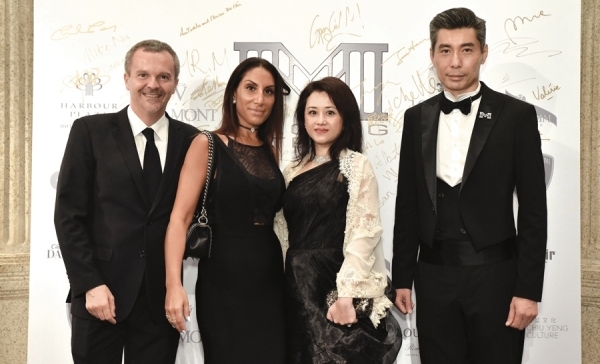
Early last month, M Racing’s inaugural gala dinner found a suitably sumptuous home at the Hong Kong Club in Central. Heading the bill at this right regal repast was special guest Christopher Cheng and the Italian Consulate general for Hong Kong, Antonello De Riu, as well as his wife, Miriam. Established by a group of keen supercar enthusiasts, M Racing Team members all have to own at least one such vehicle, with Maseratis and Lamborghini said to be particularly popular.

Click here to see A la Car Dining on video