
Norwegian Cruise Line executive discusses the company’s 3 luxurious options

The Regent Seven Seas Cruise is considered by many to be the world’s most luxurious all-inclusive cruise line. With an onboard spa and a balcony attached to each suite, the US$450 million (HK$3.4 billion) Regent Seven Seas Explorer ship is without doubt the most opulent option from Norwegian Cruise Line Holdings Ltd. However, it’s not the only way to sail the seven seas.

In addition to Regent, Norwegian Cruise Line Holdings Ltd. operates two other lines – the eponymous Norwegian Cruise Line (NCL) and Oceania Cruises.

Steve Odell, senior vice president and managing director of Norwegian Cruise Line’s Asia Pacific operations, recently stopped over in Hong Kong. Based in Sydney, Odell has more than 30 years of experience working in the luxury cruise industry, including 17 years at Silversea Cruises.

Gafencu met with Odell at the Langham Hotel to discuss what Norwegian Cruise Line can offer to different types of customers.

What’s the difference between the three brands?

NCL has the big ships. They can carry 2,000 to 4,500 passengers, and there are 14 ships now. The Regent brand is the top of the pyramid, so there are four ships, which carry around 700 passengers per ship. It’s all suites and balconies – very high-end. And then in between you have Oceania, which has six ships, and they’re slightly larger at 700 to 1,200 passengers. So you’re catering to different markets.

I always try to make the comparison with hotels. If you’re coming to Hong Kong, Regent might be the Upper House, Oceania might be the Langham and then the NCL product is probably more of a Marriott or something in that 4-star range.

What type of cruise appeals most to Hong Kongers and mainland Chinese?

The story differs by brand, but we sell all three brands very well. But most Hong Kong people who take our cruises go further afield. They go to the US, to Alaska and to Europe. They tend not to cruise in their backyard here in the Asia Pacific region.

The China business is almost entirely backyard business. The mainland Chinese cruise market is very focused on cruises out of Shanghai and Tianjin, and the cruises are mostly three to five days. I think the more sophisticated travel markets in Asia, particularly Hong Kong, Japan and Singapore, are going further afield. It’s a different market.

What’s the selling point of Regent Seven Seas Cruises?

It’s about giving people the ultimate experience at sea. It’s about making people feel very special, and it’s about attention to detail. One of my old bosses used to call it ‘anticipatory service’thinking about what the customer wants before they’ve thought about it themselves. I think that sums up luxury because our customers come from beautiful homes, they travel business class around the world and they have high expectations. If you can deliver something that is polished and memorable, and something where they feel really special and recognised, that’s what that brand is about.

We just finished building a ship last year called the Seven Seas Explorer and it’s the most luxurious cruise ship ever built. This ship has the widest choice of restaurants we’ve ever had. It’s got six restaurants – all of a very high standard – plus 2,000 pieces of artwork that were personally chosen for the ship. There’s a spa, and even a culinary kitchen where people can learn to cook. The delivery of service and making a guest feel like they’re the most important person there is key.

What sets Regent Seven Seas Cruises apart from competitors?

With Regent we are the most inclusive, and that’s the thing that sets us apart. We include excursions and we don’t charge for speciality restaurants. We include fine wines, champagnes, drinks and gratuities. So once you’ve paid, you really don’t need to spend anymore. We also have the widest dining choices on our Regent ships. And these are really spacious vessels. We carry 700 people, but that kind of ship in other brands would carry about 1,200 passengers, so our big point of difference is the amount of space we give the passenger. It’s the ultimate luxury hotel on water.

What are some of the details that go into the creation of a cruise line that customers may not realise?

We tend to work on a 36-month window for planning itineraries, and one of the challenges today is people are booking earlier and earlier, so we have to commit to itineraries earlier and earlier. Our planning department needs to be talking to ports around the world three years in advance to block availability because, as more and more cruise ships are arriving, it’s becoming more difficult to gain access to ports.

The other thing is giving people new experiences. You can churn out itineraries that repeat, but that’s not good enough because luxury travellers are looking for the next big thing. The best recent example is Cuba. I can remember 25 years ago when I was starting out in the business, Cuba was always a discussion point, and then finally it happened. We had our first cruise into Cuba on 10 March with Oceania, and all three brands, including Regent, now have permits to go to Cuba. That’s the kind of thing that most consumers don’t realise – the amount of work and lobbying, and the political hurdles that we have to get past in order to be able to do something like that.

Text: Emily Petsko

Meet Andre Morkel, the gemmologist who doesn’t mince his words

_MG_0152R

Andre Morkel is chairman and CEO of Morkel & Sons Fine Jewellery and Consultants. He is also a founding partner and chairman of ADAMAS Fine Jewellers’ Joint Chiefs of Staff.

Did you grow up in Hong Kong?

Yes, I’m a fourth-generation Hong Konger. So that makes my kids the fifth generation. I have an elder son who is 15 and a younger son who is turning five. From the get-go, my great-grandfather was involved in stockbroking in Hong Kong. He was chairman of the stock exchange, and the majority of my family worked in broking. A lot of them were lawyers in the finance industry and worked in hedge funds. I wanted to do something different and branch out, which I guess makes me the black sheep.

Click here to watch the video

How did you break into the jewellery industry?

I went to a luncheon about 10 years ago with a very good friend, and it was there that I met the owner and chairman of Ryder Diamonds, Sally Ryder. The minute I met her we just clicked and she said, ‘Why don’t you come in?’ and I thought, ‘Why not? It looks interesting,’ so I dropped everything to take up gemstone training. From my first day, she threw me into the deep end. I had knowledge of gems and diamonds but not like this. She gave me all these stones and said, ‘Sort them.’ I said, ‘Sort what? There are hundreds of stones here. What do you want me to do?’ I eventually caught on, and the training was phenomenal. I began to understand how the guys in the workshop twisted the gold, how they did the moulding and how long it took. I used to – and still do – come back with cuts and bruises and burns.

Ever since we started ADAMAS, my partner and I have received a lot of enquiries for jobs because people think it’s a luxurious industry. But it’s also hugely hard work. Now, it’s getting harder and harder to convince clients to buy because the market is so saturated, and the majority of our clients are uber high-end and high net-worth, so they already have so much stock and don’t need anymore. We hit a roadblock with that last year, but we took a different marketing approach and the interest started sparking again. 

_MG_0296R“This ring was designed for our younger son – it’s dubbed the Avrae Dragon Ring, which means eternal fire”

Have you been hit by the recent downturn in the jewellery market?

It has been difficult at times. Last year, people were calling it the ‘death market.’ I don’t agree with that, but it was tough, absolutely. Every industry took a hit, not just the jewellery industry. In my mind, though, we just had to find a loophole. There’s always a way to manoeuver back into a market that’s in a slump to recapture some of your clients. There’s always cash somewhere.

I listen to (life success coach) Tony Robbins a lot – he’s one of my biggest mentors – and one thing he says is, ‘If you want to take the island, then burn the boat.’ And that’s what we did. We don’t compete against the ‘big guys’ – the large jewellery brands – but we find ways of supplying clients with products that are more attainable to their budget. A lot of people want that 5-carat gemstone and they’re adamant it must be Cartier branded, but we can supply something of equal calibre at a fraction of the cost. We started small but gradually grew over time to what we are now, and we’re doing considerably well given the current market. We have a small following of private clients, which is growing nicely.

What sets ADAMAS apart from other jewellers?

My passion is the stones themselves, the designs. A lot of retailers have nice stones, but the salesmen don’t understand what they’re selling half the time. I have suppliers globally, and I have a very good supplier based in Hamburg who flies to South Africa and sources stones from mines around the country. He sends me the most unique paraibas and the rarest tanzanites. That’s one of our selling points because I can send those rare stones to high net-worth clients – and not just the ladies, but also the guys. A lot of the guys want ruby and sapphire rings. They want Sri Lankan blues, Burmese blues and Muzo emeralds. The Muzo mines (in Colombia) are drying up now, so people are after Muzo emeralds.

 “For my morning meditation, I have what I call my Bruce Willis Die Hard breakfast of cigarettes and two coffees”

The design is also key. I recently designed a piece for a high net-worth client using a rare paraibas that you will never find again. I designed it and we crafted it, which takes up to two months. It’s a one-off ring that’s never going to clash. That is crucial in Hong Kong, where ‘tai tai syndrome’ is a real concern. If you’re sitting at a big banquet and, God forbid, three tai tais are wearing the same ring, there’s going to be a big fight. So we ensure that we never make more than one. Everything is bespoke and customised to the client.

The problem with a lot of clients is they can’t visualise what a loose stone would look like as a piece of jewellery. If I give a client a loose ruby, she cannot visualise how it would look, and I can immediately see in my head what the jewellery should look like by the way she’s dressed, the way she looks, her smile or non-smile, whatever it may be. They say you can judge someone within 10 seconds of meeting them – I can look at a stone and straight away say that it needs to be set in rose gold, for example.

You’ve said that you don’t want a customer, you want a client. Can you elaborate on that?

A customer is someone who comes once. Whether they spend $2,000 or $5 million, I don’t care. I want them to be happy, and I want that phone call from them later on. A lot of businesses will ask, “How are the kids?” and they’ll call to wish you a happy birthday, and then – bam! – they suddenly ask if you want another ring. It’s typical, and you know it’s phony. With a client, there has to be sincerity and honesty, and that’s what we do. A lot of our clients know that my family has been through hell, so there are no false happy birthdays because they know I don’t have time for that. If I say it, I mean it.

What’s one of your favourite pieces of jewellery that you’ve designed?

This ring was designed for our younger son – It’s dubbed the Avrae Dragon Ring, which means eternal fire. It’s a tribute to his battle with cancer because he was born in the year of the dragon. I own lots of dragon-related items – my shoes, my belt, my keyring, my watch. The stone featured is a rubellite, which is said to bring good health and prosperity.

_MG_0257R

You’ve recently gotten more involved in raising awareness about cancer. How has your son’s diagnosis changed your life?

He’s doing chemotherapy, which certainly takes a toll. He started on 4 November last year, and his treatment was extended until November 2018. It’s pretty draining, especially because he is so energetic. He doesn’t take many breaks, which means no one in our house gets a break. We also have to be extra cautious when we go out because his immune system is shot, and he can easily pick up a virus.

At one point, I shaved my head to support him. We want to create more awareness about cancer because that conversation is lacking in Hong Kong. My wife joined a support network, but it’s based in the US. Why don’t we have one here? It’s a tough and stressful experience, and that’s why we want to set up a support network to help parents who are going through this so that they have something to fall back on.

When you have free time, what do you do to unwind?

I like to build RC (remote control) racing cars, which have now overloaded my son’s room. Fish are another fascination of mine. I have a big carp collection, and I find them very relaxing to watch. I have 12 now, so I’ll have to build a proper pond to accommodate them in the summer. We also have piranhas, which is a little bit crazy.

Music is another big release for me. For my morning meditation, I go upstairs and have what I call my Bruce Willis Die Hard breakfast of cigarettes and two coffees, and I listen to music and try to relax for 10 minutes before I start the day.

I also collect a lot of memorabilia, which drives my wife insane. I have a samurai sword, a sabre tooth skull and Sylvester Stallone’s boxing boot from Rocky, which faces my desk. I look at that, and it’s a constant reminder to never give up.

So when I buy these things, they’re not just random pieces – they’re reminders not to drop the ball. I try not to absorb negative energy. Most people nowadays are on so many drugs and antidepressants because they’re listening to everyone else, but if you listen to people like Tony Robbins you’re already on a high. I listen to him every morning, just a snippet of whatever he’s got. It doesn’t matter if you don’t make a sale for the day – don’t worry about it. Don’t think about it. Just live for today.

Thank you.

Text: Emily Petsko

Gourmands’ delight: Taste satisfies needs of hungry Hong Kongers

Following its successful inaugural event last year, Taste of Hong Kong returned to Central Harbourfront recently.

Visitors were not put off by the gloomy weather as they sampled dishes from some of Hong Kong’s best restaurants — Amber, Zuma and Mercato to name a few — over the event’s four days.

To make sure no one left hungry, bored or sober, Taste also featured a number of events to keep foodies entertained.

Taste Theatre held 24 sessions showcasing secret cooking techniques and tips from chefs and tastemakers. Lashings of champagne were served at The Laurent Perrier Champagne Bar and gourmands created their dream menu from more than 50 signature tasting plates and one-off festival creations.

We met with Simon Wilson, head of IMG Culinary, Asia, to discuss this year’s event, what he thinks of Hong Kong’s food scene and the future of Taste. We also managed to grab a quick word with chef Paul Eschbach from Mercato and chefs Ryusuke Higuchi and Eddy Lee from Zuma.

Text: Andrew Scott

Meet the designer behind Philippe V, Hong Kong’s most rebellious brand

Philippe Vergez is co-founder of Philippe V, a Hong Kong-based jewellery, eyewear and accessories brand.

With its edgy style and rebellious motifs, the brand embraces ‘anarchist values.’

Items are available for both men and women, and the collection includes skull-shaped rings, rebellious t-shirts and studded sunglasses, to name but a few.

Vergez, originally from France, teamed up with long-time friend Thierry Halbroth to create the brand in Hong Kong.

In their own words: “Philippe V values individuality and encourages it through stylish rock’n’roll and rebellious icons, designed for the 21st century. Similar to a members-only club, the brand aims to unite like-minded individuals by giving them a sense of belonging and letting them express their nonconforming entity through historical iconography – like the skull or the fleur de lys.”

Gafencu met with Vergez at his Hung Hom studio to discuss his work and latest eyewear collection.  

The brand you previously designed for, Jee Vice, was quite popular among celebrities. Is Philippe V experiencing similar success among A-listers?

This brand is pretty new so we are working on product placement in movies, and some celebrities like Amber Heard are already wearing our products. Brad Pitt has just received his order.

In the past, the brand I was designing for, Jee Vice, was very popular in Hollywood. It was the most popular brand at that time so we were featured in a lot of movies, and a lot of stars were wearing our glasses, like Sarah Jessica Parker, Jennifer Lopez, Rihanna, Anne Hathaway, Katherine Heigl, Amber Heard and many more.

We were the only brand of sunglasses that Anna Wintour wore, apart from Chanel. But that was another life, another brand. I’m starting a new story, but we are looking to do something similar to what we did in the past.

Your jewellery and eyewear designs often feature two symbols – the fleur de lys and skulls. What’s the significance of these symbols?

Our logo is the fleur de lys (lily flower), which has been in my family since the 13th century – not because of nobility or royalty or whatever. The story is even nicer than that.

My family came from a small village in the Pyrenees, the mountains between France and Spain, called Aspin en Lavedan. From that plateau you could see if someone was coming, maybe three hours before they physically arrived. So they warned the next valley, and from valley to valley everybody knew that someone was coming.

My last name is Vergez, and there were about 53 families named Vergez in that area, so to differentiate them they attached the name of the closest mountain, valley or river. Since my family was looking towards France, we were called Vergez-France, and since we were surveying the Kingdom of France and the lily was the kingdom’s symbol, that’s why I chose it as the company’s logo.

It’s also an important symbol worldwide because it’s the symbol of the holy trinity. The lily flower is to the Occident what the lotus is to the Orient.

As for the skull, I’ve always liked skulls but I wanted to make it different. The lily is a little different from a normal lis because the three petals are free; normally there’s a ring holding the three petals, but I wanted it to symbolise freedom. With the skull, I wanted it to have a modern twist, so the skull is multi-faceted. Skulls remind us of the past and the people who have left us and the lessons we learnt from them.

What type of client do you market your products towards?

We don’t market based on demographics. It’s more about a sense of belonging – people who like what we do and the values that we promote. We don’t really sell the product. We sell those values. I like to make a design that has a story behind it. I don’t make things just for people to buy. I design to touch people’s hearts.

Where are you from, and what brought you to Hong Kong?

I’m from a small city in the Basque country called Biarritz on the shore of the Atlantic Ocean and at the foot of the Pyrenees mountains. Nowadays, we’re not Spanish, we’re not French – we are Basque. That’s very much a strong identity for us, and it’s part of my heritage. It’s a very nice city with beautiful waves. It’s like a European California, and it’s a surf city.

After the Jee Vice adventure, I lived in the US for some time, then came back to France before moving to Hong Kong to develop the design centre of a French company. I worked shortly after that for a Danish fashion brand and soon decided to launch my own venture together with long-time friend Thierry Halbroth. I worked three years on the development and design, and Thierry supported the efforts and wrote the story and marketing strategy.

We could have based the brand in France but the economy there is pretty dramatic at the moment. The French tax and social system makes it difficult to run a business and launch a brand, It is easier to make things happen in Hong Kong. And the second reason is that I like it here – except in the summer! Too hot and humid.

What are some of the highlights of your newest collection of eyewear and sunglasses?

Apart from the design, the highlights would be the fit and the quality – both the quality of the manufacturing and the quality of the lenses that are developed together with Essilor, which is the number one company in the world in terms of optical quality.

And once again, I don’t design to make a product. I design for people. I want people to feel good, look good and take pride in wearing the product. When they try these sunglasses, they say, ‘Wow, it fits well. It’s light and it’s comfortable.’ That really makes a difference.

For more information on Philippe V, visit www.philippev.com

Text Emily Petsko

Noah’s Ark and Jewellery: Gafencu speaks to Van Cleef & Arpels President Nicolas Bos

Fans of Van Cleef & Arpels now have the opportunity to get an up-close look at one of the jeweller’s most fantastical collections yet. Inspired by the Biblical story of Noah’s Ark, the collection – now on display in Admiralty – features more than 40 pairs of animals in brooch form, including monkeys, swans, butterflies, kangaroos and exotic birds. There’s even a unicorn and a phoenix, bringing a touch of the whimsical to such a timeless tale.

As visitors enter the darkened room, they are met with a fully immersive experience. Claps of thunder and the sound of rain fill the room, and the occasional flash of lightning adds an exciting touch. The exhibit was designed by Robert Wilson, an American theatre and visual artist who is renowned for his creative use of light. The installation was first presented in Paris last September.

Gafencu spoke to Van Cleef & Arpels CEO and President Nicolas Bos, who was in Hong Kong for the exhibit.   

You started out as a marketing director for Van Cleef & Arpels in 2000. How did you get to that position?

It was a bit by accident to be honest. I started working for the Richemont Group at the Cartier Foundation for Contemporary Art right after school.

I always had a passion for art and creativity so I was happy to work in an environment that combined art with commercial and business aspects. When Richemont acquired Van Cleef & Arpels, the president, my former boss Isabelle Guichot, was appointed and she asked me to join.

Interestingly, I wasn’t asked to join because of my knowledge of jewellery, but because I’d always been in an environment with creative people trying to organise projects and make things possible. That was pretty much my role at the Cartier foundation.

My role as marketing director was more of a title than anything because there was no marketing department before I joined. We don’t do things according to market research or trends. It is primarily what we want to do in house. The purpose of the department, and the role I filled at that time, was to make sure Van Cleef & Arpels’ creations were turned into projects and collections for the stores. My role was more to organise the whole creative process and move it forward.

In 2009 you were promoted to vice president, while keeping your position as creative director. How did you balance two very different roles?

It was quite organic. The company is quite small so I was just working with a different process.  I moved to New York to take care of the American subsidiary while keeping my creative role. I moved back four years ago to take over as president.

Now you are president and CEO. What’s changed at Van Cleef & Arpels under your leadership?

I don’t think much has changed. It is about continuity. I’m not the type of manager who starts a revolution and makes big changes.

I’ve been at the company a long time and continuity is important to brands like ours. Van Cleef & Arpels has been building an identity, signature style and level of expertise for many years. I’m not the sort of guy to change the strategy and retail policy. Creation and creativity are still at the centre of everything.

The only change is I don’t have anyone to blame now. The comfort of blaming another person if something isn’t working has gone, which is actually quite nice.

How would you describe your management style?

It’s very collaborative. I rely a lot on my teams. I try to strengthen the culture among the teams at all levels. I’m not the sort of person who asks designers or collaborators every week what they’re doing or how they’re doing.

There are some projects I run with them directly and then I expect them to understand and replicate it by themselves.

I don’t like when people say, ‘It is going to be like this because this is what I like or don’t like.’ I always try to explain why I’ve made a decision and it isn’t always a matter of personal taste. It is sometimes to do with tradition or a commercial aspect. The process is a learning curve for everyone.

How does Van Cleef & Arpels remain true to its heritage while at the same time keeping up with ever-changing demands?

The evolution of the market, the economy and clientele don’t influence the identity, design or craftsmanship of Van Cleef & Arpels. To make specific collections for a market or react to a downturn or an upturn in the market is very dangerous for brand identity.

Speed of change today is so fast that there is no way you can follow what’s happening.

The whole process in making a collection takes about three years and opening a store also takes years so it’s impossible to react to trends that happen over a couple of months. It’s better to stay who you are and then explain and express your identity by using the evolution of the market.  For example, there are new ways to tell stories and bring information to clients now that didn’t exist 10 years ago. So we stay true to today’s world but the information we pass through these new mediums hasn’t changed.

Is the market in Hong Kong different to the West? If so, how?

Originally, the market wasn’t that different. We are a brand that appeals to a type of customer who knows what jewellery they like, which means we have a consistent type of clientele. Hong Kong is very similar to markets in New York and London with the types of jewellery people like.

However, the level of tourism to Hong Kong over the last 10 years has changed the retail landscape.

A few years ago in Hong Kong was the first and only time we had to organise a line outside one of our stores.  For a few years it was an unusual situation when tourists came to Hong Kong with such an appetite for luxury goods. This was something we had never seen anywhere before.

It is quieter now here which is closer to our identity.

The exhibit, called L’Arche de Noé racontée par Van Cleef & Arpels (Noah’s Ark told by Van Cleef & Arpels), will be on display from now until 26 March at Asia Society Hong Kong Center, 9 Justice Drive, Admiralty. It is free and open to the public.

For more information or to book a visit between the hours of 12pm and 8pm, visit www.vcaarchedenoe.hk.

Text: Andrew Scott

Additional information: Emily Petsko

Actress Clara Lee talks about her childhood, acting and fashion

A-2421

Clara Lee has landed roles in a number of films including the recently released Qing Sheng.

Click here to watch the photo shoot

Am I correct in saying that you spent a good deal of your youth travelling?
Yes, my father was working a lot in Europe, so I was born in Switzerland. My mother studied in London so that is how I received my UK citizenship. I, however, ended up studying in California and now I work in Korea.

Having seen quite a lot of the world from a young age there must be a few cities that left an impression on you. Do you have any favourites?
I love travelling because I get to meet different people, feel the different vibes in each city and immerse myself in the culture. I feel like I learn a lot by travelling so I really enjoy it. Recently when I spent time in Verona, Milan and Rome, it was very different. I had been to Milan before to shop but I didn’t really get to see much of the city, but this time around I found it very romantic. Ideally I would love to spend more time in Europe as it has now become one of my favourite places to visit.

Being so well travelled, in terms of nationality would you call yourself Korean, British or a ‘citizen of the world’?
That is difficult to say. People know me generally as Korean, so if I were asked I would say Korean. When people ask about where I grew up or want to know more about my background then I explain to them about my UK citizenship and how I spent my youth travelling a good deal.

Your father is a famous musician and your mother a talented ballet dancer. Have you inherited any of these artistic genes from your parents?
I don’t really think about it in terms of inherited talent but I do really enjoy dancing, listening to music and singing, so perhaps I did inherit some aptitude genetically. If that is the case, I certainly appreciate it! I am actually doing some work on the musical side and some ballet dancing. Hopefully I will be releasing an album in 2017.

C-0395

Another one of your talents is fashion design, which you studied at university in California. Is that something you are still involved with now?
Yes that is why I recently started collaborating with the lingerie brand Charmante; it’s allowed me to get involved with fashion again. I have always been interested in fashion design so anytime I am presented with the opportunity to get involved I absolutely jump at the chance. I feel like my recent collaboration with Charmante is a great start.

You began your career as a model before making the transition onto the silver screen. Was there a particular moment you remember wanting to be an actress?
I think I always aspired to be an actress. I remember the first day I was on set working on a Korean drama, I was very nervous but as soon as the director started shooting my nerves turned to excitement. Whenever I am in front of the camera I feel very passionate and excited. Acting is something I really love to do.

What is it that you love so much about acting?
Everything! I feel like acting allows me to get in touch with myself. I feel like I didn’t know very much about myself before I started acting. Being in front of the camera makes me much more aware of how I talk, where I look and how I use my hands. I am starting to learn more about myself and learning to love myself, which is a very exciting journey.
I am generally a quiet person, not that outgoing and I only have a few friends. But when I have to play a ‘bad girl’ I am forced to be boisterous and act out by screaming or throwing tantrums, so it was interesting to see that part of myself come out, a dark side I didn’t realise I had. Other times when I play a doctor, for example, I feel happy that I can get in touch with my more intellectual self. Acting, for me, is about studying life and looking at different careers and people with very different personalities. I enjoy playing different characters and finding different sides to my own personality.

B-0085_eff2

 “I feel like acting allows me to get in touch with myself. I feel like I didn’t know very much about myself before I started acting…”

It sounds like you get quite wrapped up in the characters you play?
Yes, most recently I shot a movie in China where I played a swordsman and kung fu master so I learned to fence and fight. It involved a lot of scenes with wires and although naturally I am quite an athletic person, I do have a fear of heights. I didn’t know I could jump out of high buildings and all that so it has really been a learning process where I discovered quite a lot about myself. It allowed me to gain more confidence and made me even more passionate about my work. I have really enjoyed doing more action recently.

Do you find the stunt and action scenes difficult?
It can be tough but I really have found myself enjoying the more physical side of acting as well. I have learnt many different fighting techniques and I really like challenging myself. I don’t like to waste time and I love working hard.

How do you emotionally prepare for more dramatic roles?
I spend time studying the character by watching films about that specific topic. Most recently, with the action film in China, there was a lot of emphasis on the poses and the looks so I did a lot of research into different action actresses and how they portray different styles on film.

Do you dream in English or Korean?
I love this question! Actually I dream in both although sometimes I surprise myself when I start speaking English or Korean in my dreams and even I get confused sometimes!

So you are just as comfortable expressing yourself in English as Korean?
Yes I would say so, depending where I am. If I am in Korea I tend to express myself in Korean whereas when I am travelling I am just as comfortable expressing myself in English.

What is it like being a sex symbol?
It motivates me to keep fit and stay active in a healthy way. I like to think that I can be a positive role model and help motivate my fans to lead a healthy lifestyle. I enjoy sharing my diet and fitness regime with my fans. I am a very positive person so I think that also helps. It is not all about being sexy on the outside. It is just as important to feel sexy on the inside and exude a bright and positive vibe.

What would you say is the secret to success in life?
I think it is still a secret to me. I just try to work as hard as I can. I believe that whatever effort I put into my work and life it will come back to me in the form of success. I feel that if I work hard enough my dreams can come true.

In the movie Line Walker you played an assassin. Being such a naturally positive person did you find it difficult playing such a dark role?
Yes it was certainly challenging. I had to scream a lot and I didn’t really have many spoken lines so all of the emotion had to be expressed through screams or facial gestures. At the time I found it challenging but once the camera started rolling I had invested so much time in my character I almost felt like a real assassin! While I was training I found it difficult and I was often too shy to scream but once we started shooting I was fine. That is why it is so important for me to have time to train and prepare for my roles.

If you hadn’t become an actress what could you see yourself doing instead?
I think I would have liked to have been a fashion designer. I am always reading about and staying up-to-date with fashion. I find fashion changes so quickly nowadays but I have my own look. I like to wear high-waisted clothing to make my legs look longer or tighter-waisted clothes to accentuate my curves. I have the kind of fashion sense that I feel looks good on me. I like to wear fitted clothing. If I wear baggy clothing I tend to eat more so I try to wear tight clothing to help motivate myself to keep fit.

You have also appeared in a few music videos. Is there a certain musical genre you are more partial to?
I like ballads and sad songs. I am typically quite a cheerful person and I used to listen to a lot of EDM and fast songs, so I would like to branch out a bit and work on ballads to challenge myself musically.

Do you have any favourite musicians?
I love Beyoncé but I can’t imagine her wanting to work with me! I love her, she is my musical motivation.

What do you do in your time off and what is an ideal day for you?
When I am in Hong Kong I like to take in the views, so I like to go to bars and restaurants on the top of high-rise buildings. The weather is perfect right now because it is not too hot and it is pleasant, so I like to stay outdoors, walk around the city and do a bit of shopping. I love places like Isola which has a great view and good food.

Thank you.

Text: Hans Schlaikier

As C.Y. Leung comes to the end of his term, we take a look at his time in office

pbu527747_02_eff

“Politics is the art of choosing between the disastrous and the unpalatable.”

So said Canadian economist and thinker John Kenneth Galbraith. With that sentiment in mind, it’s difficult to think of public figures more polarising than Hong Kong’s incumbent Chief Executive, C.Y. Leung. However, there was seemingly a genuine and unified reaction of shock when Leung – having served as the city’s top official since 2012 – announced his decision not to seek re-election this year, after serving just one term as Hong Kong’s political leader.

“After I made the announcement I knew that I could now have more time for my family, and I felt relieved. My family supports my decision,” said Leung.

C.Y. Leung – or Leung Chun-ying, to quote his full name – was born on 12 August 1954 in what was then British Hong Kong. He was afforded a scholarship to King’s College in Hong Kong, where he attended secondary school before studying at Hong Kong Polytechnic. Upon graduating in 1974, Leung undertook further studies at Bristol Polytechnic in the UK before finishing first in his class in 1977.

Although he was undoubtedly a good student and a diligent worker, there was little at this point to suggest that Leung was destined for a future as Hong Kong’s top politician. His career began modestly with a job at real estate company Jones Lang Wootton (JLW) where he worked for five years.

16049037058_bd0bc2deeb_o_eff

“While Leung’s tenure was a mixed bag, it’s fair to say he fulfilled some of his campaign promises”

Upon leaving JLW, Leung joined the Hong Kong Basic Law Consultative Committee in 1985, his first foray into politics. Leung would later become real estate advisor for Zhu Rongji, when the latter was mayor and party chief in Shanghai from 1998 to 2003. Zhu would go on to be vice-premier and eventually fifth premier of the People’s Republic of China. It’s not difficult to imagine that this time spent in such elite political company may well have sown the seed that would blossom into Leung’s steadfast political ambition.

Officially announcing his decision to run as Hong Kong Chief Executive in 2011 – two years after hinting at the prospect – Leung was elected on 1 July 2012 after a hard-fought campaign.

After five years in the hot seat his term comes to an end later this year. In today’s fleet-footed digital age, where information travels ever-faster and attention spans grow ever-shorter, Hong Kong has already turned its rapt attention to the next election for Chief Executive.

Leung gave his final policy address recently, in which he was quoted as saying: “I don’t want to create any legacy, but I think it would be useful for everyone to actually go through the policy addresses of the past five years … and ask whether or not these are the right policies and measures that people in Hong Kong need.”

in mind we take a look back at some of these policies and measures and ask exactly what kind of reluctant legacy will C.Y. Leung leave as Chief Executive?

15223465970_66a8abc6f4_o

While most will agree that Leung’s tenure as Chief Executive was a mixed bag at best, there are those who cannot deny that he managed to fulfil some of his campaign promises successfully.

Welcomed by workers but not as well received by businesses, Leung finally announced his intention to scrap the controversial Mandatory Provident Fund offsetting mechanism during his final policy address on January 18th this year. The offsetting mechanism previously allowed employers to use money they put into workers’ retirement funds to cover their severance and long-service payments. Workers considered it an unfair policy, which has sparked controversy and protests since the policy was introduced in 2000.

To ease the transition, the government is expected to subsidise the new setup over the next 10 years – with an estimated cost of HK$1 billion for the first year alone. While this comes very near the end of his term, it is nonetheless a campaign promise fulfilled, much to the approval of the average Hong Kong worker.

Other successes that Leung has enjoyed while in office include promptly dealing with the milk powder shortage brought on by reports of tainted milk powder on the mainland in 2013. Parallel traders from the mainland made life difficult for local mothers when they bought up local stock of milk powder to bring back across the border for re-sale. Leung swiftly declared a limit of two cans per person, which alleviated the shortage and brought relief to local mothers.

Similarly, Leung also acted decisively when mainland mothers were overwhelming the supply of hospital beds in Hong Kong. Pregnant mainland mothers made their way to Hong Kong in large numbers for dual purpose: to take advantage of the city’s premium private healthcare, while hoping to secure Hong Kong residency for their child by giving birth in the city. Leung curtailed the strain being placed on local maternity wards by announcing a ban on non-local parents having babies in Hong Kong. This resulted in the number of babies born to non-local parents being cut from more than 35,000 per year to about 800 per year and freeing up much needed maternity beds for local mothers-to-be.

One of Leung’s major campaign promises was addressing Hong Kong’s housing shortage. Leung has made this a priority but has arguably had less success in this area.

At the end of 2016 the government announced it would maintain a target of adding 280,000 public flats and 180,000 private flats to the housing market within a decade. While efforts have no doubt been made in identifying potential land for re-development, the shortage of readily available land and opposition to re-zoning of existing land has considerably hampered any real progress. Despite his best efforts, Hong Kong retains the undesirable honour of being one of the world’s most expensive cities to live in – not least due to the high cost of apartment rentals.

“After I step down, I would like the new government to continue to look after the underprivileged”

Another issue high on Leung’s agenda has been attempts to address environmental pollution in the city. Again, critics will claim that more could have been done while others have praised Leung’s initiatives to force ocean-going ships to switch to cleaner fuel and efforts to replace thousands of heavily polluting vehicles. While this has undoubtedly had some impact on the city’s air quality, Leung and the government have made little headway in addressing the city’s waste disposal issues.

In terms of environmental conservation, Leung’s government was lauded for a plan to phase out the local ivory trade by 2021. However, others point to hypocrisy in the fact that no allowances have been made for Chinese white dolphins – a species that is currently in danger of extinction. Its habitat is under dire threat from infrastructure projects such as the Hong Kong–Zuhai–Macau bridge.

It would also be impossible to talk about C.Y. Leung’s tenure as Chief Executive without mentioning Occupy Central. In late September 2014, students and protestors took to the streets to rally against a decision by the Standing Committee of the National People’s Congress (NPCSC) regarding proposed reforms to the Hong Kong electoral system. The decision was widely seen to be highly restrictive, and tantamount to the Chinese Communist Party’s pre-screening of the candidates for the leadership of Hong Kong.

What followed was 79 days of protests, where students set up camp in several of the city’s high-profile areas. On the first night of the protests, events culminated in the firing of tear gas by police on protestors on C.Y. Leung’s order. Not only was this incident harmful for Leung’s poll numbers but it also thrust Hong Kong politics firmly into the international spotlight, no doubt much to Beijing’s annoyance.

In policy terms, C.Y. Leung has himself declared that he has basically delivered on all his election promises, while his critics point to a lack of initiatives to heal the social and political divides that have marked his time in power. On the other hand, he has also been hailed for his shift of focus from pure politics to more developmental policies that address the standard of living in the city.

“After I step down, speaking as a Hong Kong person, I would like … the new government to continue to look after the underprivileged, particularly the elderly,” says Leung.

For better or worse, C.Y. Leung has left his indelible mark on our city. As with anything political, it might be some time before we can actually gauge the effectiveness of his policies. One thing is certain, though. Whoever wins this year’s election has quite a job ahead of them.

Text: Hans Schlaikier

Mr Electric: Michael Kwan talks about his family, work in electronics trading

_MG_6553_eff

Michael Kwan is the chairman and owner of electronics import-export company Vibrant Development Limited. He is also a former president of the Rotary Club of The Peak.

You spent a number of years studying in the US. What did you do there?
I first went to the US in the early ‘80s when I was still in high school. I went on to graduate from Peddie School, a private institution in Hightstown, New Jersey, in 1982. I then studied psychology at Texas Christian University in Fort Worth, Texas, and after graduation I returned to Hong Kong to work. Texas was fun, but it wasn’t all that exciting because it was still quite old-fashioned in the ‘80s. I imagine it’s very different now, but I’ll find out for sure when I revisit this June.
Back in the early ‘80s, a lot of people my age, who studied abroad, returned to Hong Kong to work in banks or financial institutions. I was never interested in banking, but with psychology I realised I could take a completely different approach to business. I could get a feel for what people wanted, and learn how I could help fill those needs.

Click here to watch the video


Your first job was working as a front office clerk for a Mong Kok hotel. What was that like?
I had never worked in the service industry before, and when I returned to Hong Kong my father brought me to the opening of a hotel run by someone he knew. When he asked me if I wanted to work there, I was pretty enthusiastic about the offer, so I accepted and worked there for a year as a front office manager trainee. I made many friends, many of whom I still see today when I patronise various hotels. My second job was also as a hotel trainee. The chain had quite a few hotels in Hong Kong, so I trained in various departments and got a broader view of what the service industry is all about. It was a lot of fun and I learned a great deal about people too.
I always wanted to open my own boutique hotel, but I was never able to do that in Hong Kong because everything is so expensive. I thought of opening a cottage-style hotel in Canada, the US or England, but I realised it’s very impractical to do so while living in Hong Kong because you have to be completely hands-on when heading up a small venture like that.

  “I don’t have to work very hard, which my wife doesn’t like. She says she works harder than I do!”

Where else have you worked, and how did you end up founding your own company?
After cutting my teeth in hotel management, I changed track and got involved with Chinese trade. I worked in several provinces in China including Guangdong, and also in the Nanjing and Nanchang areas, where we invested in a couple of factories that built electronic components.
I was involved with three factories there, and then I took on another project that required me to move to Macau for two years. We produced copper anodes to be sold as electrical plating for PCB boards, which are installed in computers and other electronic products. I worked there for two years until the Macanese government took the land back and started developing casinos. So I returned to Hong Kong and started my own company, Vibrant Development Limited. I’ve been able to use the knowledge I gained from working in factories, but now I’m selling the basic components like resistors and capacitors rather than manufacturing them. Over the last several years I’ve also helped my family’s company with real estate rentals and renovation projects for our buildings. It’s great because I get to know all my tenants and see what they need and how we can improve upon what we do.

What’s a typical day for you?
My days are quite relaxed now because the business is on track and it’s essentially self-operating. In the morning I talk to my business associates and see if my tenants have any problems – a leaky faucet or busted water pipe, for instance. If there are no issues, I usually stay in the office for lunch and leave around 4 o’clock. Sometimes I’ll go and play golf or work out, and on other days I’ll pick up my son from basketball practice. I don’t have to work very hard, which my wife doesn’t like. She says she works harder than I do!

_MG_6398“We trust our children to decide for themselves what is best in life. All we really want is for them to enjoy themselves.”

You have two children, Chloe and Christian. Do you have any family traditions?
Every Chinese New Year we go skiing somewhere like Japan or Europe. Skiing is fun if you know what you are doing. But since I learned to ski at a slightly more advanced age, it didn’t come naturally to me, and it was harder to come to grips with the trepidation.

I do enjoy watching my family ski or snowboard though. It’s an incredible thing that I only get to see once a year. My wife, Vanessa, struggled to keep up with our son Christian last time because he’s practically a pro now, and he likes to go all the way to the top of the mountain. Vanessa usually stays with him for half the day, and for the other half we’ll take a walk or get a massage. Another reason to avoid the slopes is that I’m getting old, and I don’t want to fall. Falling is no fun.
One thing I do like about skiing is the fashion. Snowboarders wear all these stylish, saggy clothes. I can’t pull it off because I don’t have the physique to wear it with grace, but my son can wear it quite nicely. Even when they’re not skiing, people at the lodges wear such amazing clothes – Monclers, furs, chinchilla. It’s a great place for people watching, especially with such incredible scenery to take in too.

_MG_6513_path

We’ve heard you also enjoy cooking. What’s your speciality?
I like to cook, but I can only make two or three dishes that I consider edible. I’m still learning. I do make an awesome roast chicken, according to my friends. I’m exploring other dishes, so maybe I’ll come up with something new in the near future. I was put in charge of Christmas Eve dinner at my mother’s, so I made roast beef and Yorkshire pudding with roast vegetables. It turned out okay. As far as I know, they are still alive!


What is your involvement with charities?

I am very involved with the Rotary Club of The Peak, which has unlimited resources to help NGOs. The club just donated a few hundred thousand Hong Kong dollars to a school for the physically and mentally impaired. It meant that they could purchase studio equipment like green screens so the students can film videos and conduct interviews.
In a separate programme, we’ve arranged for famous radio hosts to come in and teach special education students interview techniques. It really gets them thinking, and they are getting quite good at it.
I’m also involved in The Great Chefs of Hong Kong charity, which is hosted by the Heep Hong Society each year. We donate money and sell seats to Rotary members so they can invite their families to enjoy dishes prepared by over 40 chefs from Hong Kong hotels and restaurants. The proceeds from this are donated to children with special needs.
To a lesser extent, I’m involved with the Society for Abandoned Animals. My family already has a rabbit and a dog at home, so we can’t afford to take in any more pets, but we like to donate money in the hope that these animals will find permanent, loving homes.

_MG_6754

What travel destinations are on your bucket list?
I’m definitely hoping to see the Northern Lights. I’ve seen pictures – they look amazing – and I’ve never been to a place where they are visible. Typically I tend to go to the same places over and over again. But if I were to venture into new terrain, I’d love to go on an African safari. Somewhere in South America would also be great, but my family is not too keen because they’re always worried about mosquitoes. And of course shopping is another big consideration when choosing a destination.

What is the most challenging thing you have done?
I’d have to say that raising a family is the most challenging because you have to accommodate other people with every choice you make. It’s not smooth sailing all the time, but we try to make compromises and live happily. One of the most difficult moments was saying goodbye to Chloe when she left home to study in the US. That was pretty tough for Vanessa and I at first, but then we had the chance to visit her soon after she left. We also managed to visit again with her brother, Christian, during his fall break. With our frequent visits, the first year was actually okay, especially now that she is settled in at school.
Many parents send their children to school in England at a very young age, but we do not believe in that. We trust our children to decide for themselves what is best. Chloe was accepted to a school in England and she decided that it wasn’t for her, so we didn’t push her. Christian got accepted to my old high school in the US but decided he didn’t like it, and I told him, “That’s fine. Stay.” Now he’s one of the top basketball players in his school. He’s also on the rugby team and involved in all sorts of extracurricular activities to keep him busy. He’s enjoying school, and that’s really all we want – for our children to enjoy themselves.

Thank you.

Written by Emily Petsko

Hong Kong Olympian Stephanie Au on passion, natural talent and making history

A-7715

Team Hong Kong swimmer Stephanie Au has competed for her home city in three Olympic Games since 2008. She was also Hong Kong’s flag bearer at the 2016 Rio games.

When did you first discover your passion for swimming?
I started swimming training at nine, but I’d say my passion really developed in college because my coach introduced a whole new angle of swimming to us. We added on new exercises like dry land training, Pilates, balancing work, high-intensity workouts and runs. We also had things like mindset coaching and we’d read up on the sport. It was a very rounded way of developing. My coach always said that we were trying to build and empower young women; he didn’t want us to just focus on the swimming itself.

Click here to watch the video

To what do you attribute your athletic success? Is dedication and training key, or is it more about natural talent?
I think natural talent to a degree. When you start training, it’s more about basic talent and your skill set, although you do need dedication to get yourself into the pool every day. Once you get older and you become more professional, it does become more about the passion. If you don’t get that feeling of passion when you’re competing at a higher level, it becomes much harder. Every time you try to beat that 0.01 second it’s much more difficult, so you need to give yourself that little nudge.

A-7607
What keeps you motivated in training? What do you enjoy most about swimming?

I enjoy the quietness of swimming and the solitude in the pool. I also like how it gets you sweating, even though you don’t feel like you are at all! The focus on breathing and moving makes you feel alive. Also, once you’ve been in the competition pool, the competitiveness is thrilling. The swimming world contains a wide spectrum of different feelings.

What made you decide to study at the University of California, Berkeley?
Some of the older girls – my swimming peers – who I’d worked with studied there; two of them went to Berkeley. I saw both of them excelling, both in academics and in athletics, so I decided I wanted to follow in their path. Realistically, I knew I could only do all three – study, train and be able to balance the work at such a high level – in the States.

A-7548
“We made history. I felt very honoured and proud to be on that team. Walking into the marshalling area with my teammates and feeling relaxed and smiling through the entire race was a precious moment.”

You studied Environmental Economics. What was that like, and is it something that still interests you?
Yes, it is. I picked that over other subjects because, unlike most student athletes who study subjects related to sports in some way, I wanted to keep my mind off swimming. I wanted to use my study as a break away from training. But another reason I picked Environmental Economics is because we don’t really get to study it in Hong Kong. In the States there is so much high-calibre research on the subject.

You were awarded an Outstanding Student accolade. How did you juggle school work and training? Was it stressful?
It was stressful, but mainly it was about prioritising and time management. Once you get that down, it’s okay. It’s easier said than done but you really need to stick to your routine. It’s relatively challenging for a secondary school-aged child, but once you can manage that, you are halfway there.

What was it like in the Olympic Villages? Did you meet and spend time with fellow athletes?
To be honest everyone is just completely focused on the competition and concentrating on their own event. Nobody wants to bother other people too much because it’s a very important game for everyone. So we do the socialising after it’s all finished.

A-7855

What did it mean for you to be chosen as Hong Kong’s flag bearer?
It was a total honour, I was so happy. I never expected to be chosen, especially at the Olympic Games. I’d always wanted to be a flag bearer. It was my third time as an Olympian, and the Olympic Committee stated they’d chosen me over the others because of the extra work I’d been doing within the sporting community and the contributions I’d made towards sports development.

Of the three games you participated in, did you have a particular favourite?
All three were very different, but I would say that the 2016 Rio Olympics were by far the best. Although I tried to go in with my individual 100-metre backstroke event and failed to qualify, I also helped the relay team get into the top 16 in the world. Just the fact that we made it to the Olympics – and it was the first time for a Hong Kong swimming relay team to be there – was so special. We made history. I felt very honoured and proud to be on that team. Walking into the marshalling area with my teammates and feeling relaxed and smiling through the entire race was a precious moment.

Apart from that, are there any particular memories or defining moments that stand out?
At the World University Games, which were held two years ago, I was competing in the 50-metre backstroke and I barely made it into the finals. During the race, most of my friends – who had been competing with me since we were 12 – were in the stands cheering for me. Once I touched the wall, I heard them screaming like crazy. I didn’t win – I got silver – but they were so happy for me, and they were cheering so loudly that I knew I had made the top three. I’d qualified as seventh into the finals, but then I ended up finishing second; I’ll always remember that moment. It’s not about the time or the medals – it’s my teammates that matter.

A-7949

If you could give a young athlete one piece of advice, what would it be?
I’d say you really need to find your passion and do something you love. You need to make sure you put your heart into it. You can’t just do it for a couple of months, and of course there will be challenges ahead, but if you really love it, you will find a way to make it work.

Where would you like to see yourself in 10 years’ time?
I feel like 10 years is quite a long time, because things could really change in 10 years! I know that in 10 years, I won’t be swimming professionally anymore. Hopefully I will find a sustainable new path and career. I want to give something back, perhaps by working in sporting development or training. Everything I have right now is thanks to swimming, and the sporting system that helps nurture athletes. So now I want to continue that cycle.

What do you do in your free time to relax? Is it difficult to unwind after a day of training?
I like just sitting still and listening to music. In some ways, it’s similar to swimming because once I put in my earphones it’s my own quiet world again. I can talk to myself and analyse my performance if I need to, all in my own small zone. And of course, I can get ready for the next practice.

Thank you.

Written by Siobhan Brewood-Wyatt

Set sail with Monte Carlo Yachts’ president Carla Demaria

Even though Monte Carlo Yachts is the new kid on the block when it comes to the luxury yacht market — launching its first unit in 2010 — the brand is starting to make waves with the backing of the Beneteau Group and Carla Demaria as president.

Gafencu spoke to Carla recently about the brief history of Monte Carlo Yachts and the importance of the Asian market to the company.

Tell us about yourself and Monte Carlo Yachts.

In 2008 I decided to work with the Beneteau group, which at that time was one of the largest yachting groups in the world, but not in the segment of bigger luxury power yachts. So they decided to enter that market.

Even though this decision was made before the financial crisis in 2008, Beneteau decided to stick to their plan and we are doing exactly what was decided before the crisis. Maybe other companies would have delayed, but Beneteau has more than 130 years of history and they had a vision.

At that time it was tough and not every company could do what we were trying to do, but the crisis was also an opportunity for a strong company to take on a new challenge, and this is exactly what happened.

Beneteau trusted me and my team, and we started from a blank sheet in 2008 with Monte Carlo Yachts.

The crisis put a lot of pressure on us, which was a good thing because we did everything we could to make sure we didn’t make any mistakes, starting from the decision to pick the design studio Nuvolari Lenard.

A lot of big names were struggling during the crisis, so our idea was to have a long-lasting product that was new and could be immediately recognised on the water. Our yachts also had to be innovative and stand out because we were new.

Beneteau put a lot of resources and money into the project and I am proud to say they have been fully rewarded. In the six years since we launched our first yacht, we have had a successful product every year.

The next step is to move forward even faster over the next five years.

How important is the Asian market to Monte Carlo Yachts?

Our product is accepted all over the world, but Asia, for us, is the number one market. Here in Hong Kong, people can be quite demanding and the fact our product is well received means we are doing the right thing. They are experts and the fact we are successful here tells us a lot.

One of the key things for our yachts is we can customise our product 100 percent, and not just in terms of decor. We have a production patent so we can tailor make every single boat for our customers.

What can you tell us about the recently launched MCY 80?

We are here in Hong Kong to present the number 6 (the MCY 80). After the company’s first 5-year cycle, this is the first boat in the new cycle.

It isn’t the biggest in the range, but this yacht perfectly expresses all the key features of our product and it is the DNA of Monte Carlo Yachts. The boat can be customised as much as the owner wants and it has the same level of detail you’d get on a bigger yacht.

Apart from being faster than any competitor, it is also made to the highest quality. On MCY 80, we have combined our experience from building the biggest yachts, the MCY 105, to the smallest, the MCY 65.

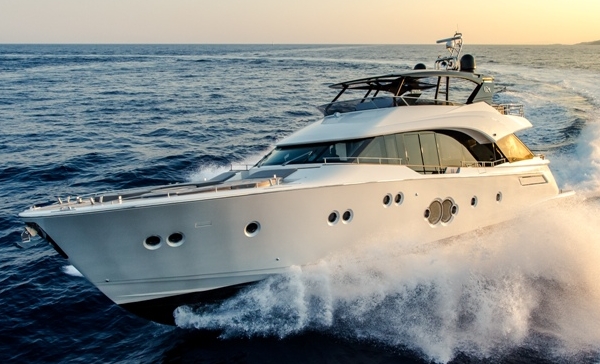
The new 24-metre MCY 80 has a class-leading entertainment foredeck and Portuguese bridge. The large full-size windows bring in vast amounts of natural light to the saloon and cabins.

Text: Andrew Scott